Actualités · 17 May 2026
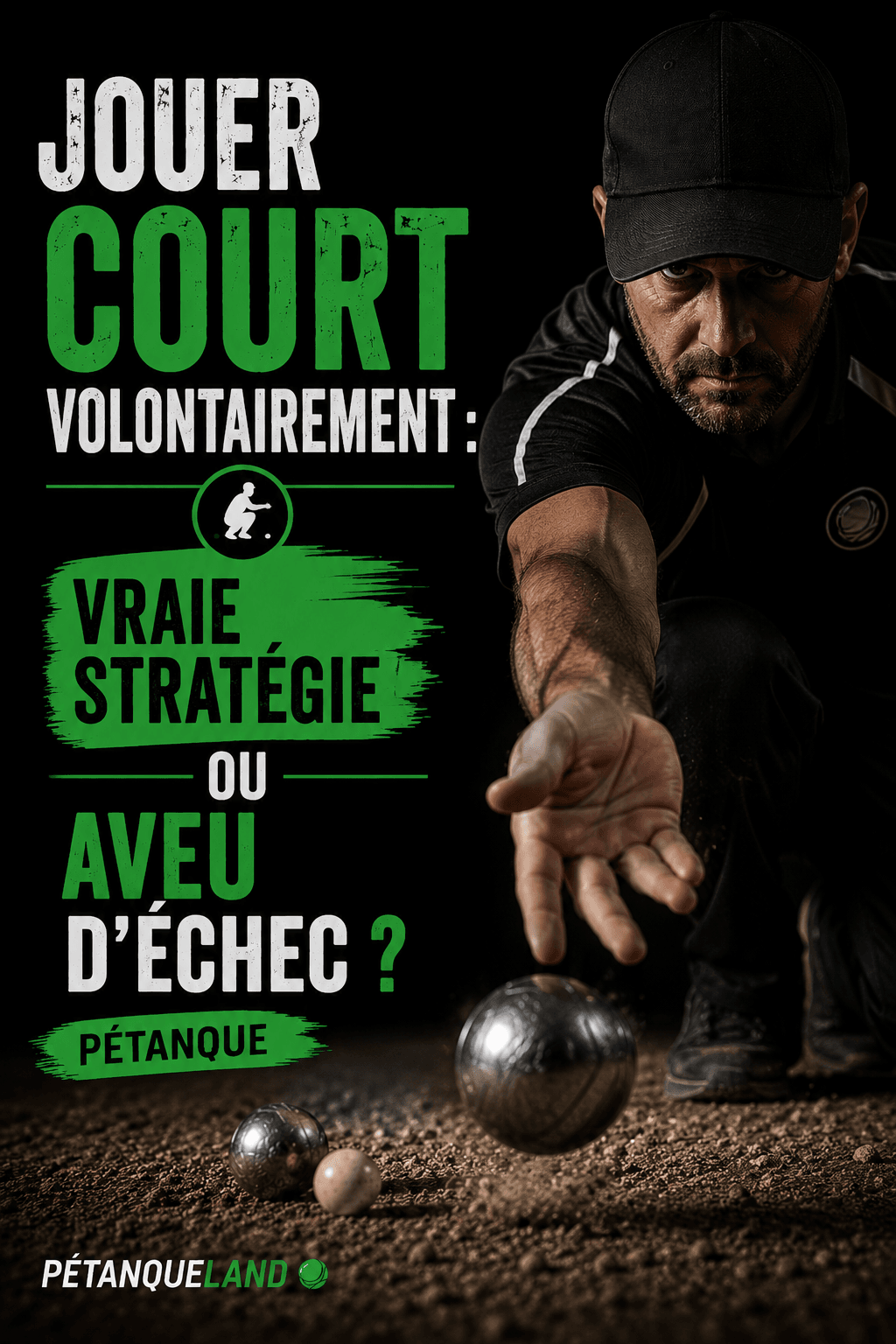
Playing short on purpose: real strategy or an admission of failure? (Pétanque)
Deliberately placing the boule short of the jack. Protection, forcing the opponent, the tempo of the end — playing short can be a brilliant tactical decision or a drift thatStrategy vs drift — the two faces of short play
🧠 PLAY SHORT — STRATEGYThe decision is made before of entering the circle. The objective is clear and expressible — "I want to protect the jack on the left side", "I want to block the shooting line", "I want to force the opponent to go past my boule".
- Decision expressed before the throw — not during the delivery
- Precise target zone — not "short of the jack" but "30 cm in front, slightly to the left"
- Contextual — used in situations where it provides a real advantage
- Owned — the player can explain why they played short after the throw
The decision was not expressed explicitly. The aim was the jack, but at the last moment, the fear of "going long" held back the delivery. The short boule came as the result of hesitation, not intention.
- Decision not expressed — or expressed late during the delivery
- Vague target zone — "somewhere in front of the jack"
- Systematic — played short on all long distances, regardless of the situation
- Defensive — justified after the fact by "protection" but without having been thought through beforehand
The 5 situations where playing short is genuinely strategic
① Protecting the jack against a formidable shooter The opponent has a very high-level shooter who regularly shoots the jack when it is accessible. Placing a boule in front of the jack, on the side of the most likely attack angle, creates a physical obstacle that complicates the shot or forces a less favourable angle. The short boule is not a short boule — it is a tactical screen. ⚙️ Logic: a boule correctly placed in front of the jack can reduce the shooter's success probability by 20 to 40% depending on its position. The objective is not to hold the point — it is to make the opponent's shot harder or less profitable. → Necessary condition: the boule must be placed precisely on the most likely shooting line. A poorly placed protection protects nothing and gives a point to the opponent. ② Blocking lateral access to the jack When the jack is accessible via a lateral lane that the opponent uses regularly, a well-placed short boule can close off that lane. The opponent is then forced to point through a path they control less well, or to shoot from a less favourable angle. This is a use of playing short to control the space, not to score points directly. ⚙️ Logic: the position of the short boule alters the ground accessible to the opponent. It does not count as a point — it counts as an obstacle that reduces the opponent's options. → Necessary condition: having observed which lane the opponent points through most often. Without this read, the short boule is placed randomly and blocks nothing precise. ③ Creating a group of boules that complicates the shot With several boules close to the jack (one's own and the opponent's), adding a short boule that brings them together creates a dense configuration in which any shot risks causing favourable ricochets. The more numerous and close together the boules are, the more unpredictable the result of an opponent's shot. The deliberate short boule helps build this tactical density. ⚙️ Logic: in a dense grouping, each metal-to-metal impact is a potentially favourable cascade. The short boule adds one more obstacle to the equation and increases the probability of a favourable result in the event of an opponent's shot. → Necessary condition: already having boules close to the jack. Creating a dense grouping from nothing requires other boules already in position — not just the short boule. ④ Sloping terrain: playing short uphill On sloping terrain, a jack placed at the bottom of the slope is hard to reach from the top — the boules tend to roll past it. Playing deliberately short, on the uphill side of the slope, creates a boule that "rolls down" naturally towards the jack if the end evolves, or that stabilises the configuration by blocking the roll of the opponent's boules coming from above. On steep terrain, the short boule placed on the right side works with the physics rather than against it. ⚙️ Logic: a short boule on the uphill side of a slope can act as a brake for boules that roll down too fast — turning a terrain constraint into a positional advantage. → Necessary condition: having read the slope before playing. A short boule on the wrong side of the slope rolls further and makes the situation worse. ⑤ Forcing the opponent to play around an obstacle When the terrain presents difficult zones (rough patches, a change of surface, a zone of random bounce), a short boule placed between these zones and the jack forces the opponent to pass through the problematic zone to reach their target. The knowledge of the terrain is used as a tactical weapon, by placing the boules to maximise the opponent's difficulties on the zones identified as dangerous for everyone. ⚙️ Logic: this is not simply "playing short" — it is using the topography of the terrain as a tactical element in its own right. The short boule is a tool for staging the terrain. → Necessary condition: having spent the first ends reading the terrain precisely. Without this read, one does not know where the difficult zones one seeks to exploit are located.The signs that short play has become a drift
🚩 SIGNAL 1 — SYSTEMATICITYThe player plays short on every boule beyond a certain distance — say every boule at more than 8 metres. This systematicity is the clearest signal of a drift: a real strategy is contextually triggered, not automatically activated beyond a threshold distance.
Diagnostic test:Count the percentage of short boules over the last 3 games. If more than 60% of the boules pointed at long distance are short, regardless of the tactical situation, the drift is likely.
A player whose playing short accounts for more than 60% of long-distance throws plays defensively by default — not strategically. 🚩 SIGNAL 2 — INABILITY TO EXPLAINAfter a short boule, the player cannot immediately and precisely explain the tactical objective of that boule. "I was protecting" without being able to say what, against whom, or how is a post-hoc justification — not a prior decision.
Diagnostic test:Ask a partner to ask the question "why short?" after each short boule. The quality of the answer reveals whether it is a decision or a drift.
The rule: if the answer to "why short?" takes more than 3 seconds to formulate, the decision was not made before the throw. 🚩 SIGNAL 3 — INDEPENDENCE FROM THE SCOREPlaying short when leading (securing) is reasonable. Playing short when behind (one needs to score as many points as possible) reveals a drift — the fear of the long distance takes over the tactical need to take calculated risks to come back.
Diagnostic test:Observe whether the proportion of short boules changes according to the score. A strategic player plays differently at 5-10 than at 10-5. A drifting player plays the same way.
Strategy is sensitive to context. Fear is blind to the score. 🚩 SIGNAL 4 — IMPACT ON THE PARTNERThe partner ends up adapting their play to the drift — they no longer expect to see long boules, they play knowing that the short boules will leave the jack open on the long side. This adaptation by the partner cements the drift as a permanent architecture of the duo.
Diagnostic test:Ask the partner whether they systematically anticipate short boules from the player. If yes, the drift has become a team pattern — harder to correct than an individual drift.
When the partner "knows" in advance that a boule will be short, predictability has become a structural weakness of the team.The decision tree — is it strategic or not?
🔀 DECISION GUIDE BEFORE EVERY SHORT BOULE 3 questions to ensure the short boule is a decision and not a drift ① Did I express the objective of this boule before entering the circle? YES — precise objective expressed The short boule is intentional. Move on to question 2 to check that the objective is consistent with the tactical situation. NO — no precise objective Stop. Step out of the circle, take 3 seconds, express the objective. If no precise objective forms, the short boule is a drift — choose another option or aim for the jack directly. ② Does my short boule benefit my position or complicate the opponent's? YES — identifiable real advantage The short boule is tactically justified. Play with intention. Aim for the precise zone that fulfils the objective — not a vague zone "in front of the jack". NO — vague or non-existent advantage The short boule brings no tactical value. Consider aiming for the jack directly or to shoot depending on the configuration of the end. Playing short without a clear tactical advantage gives a point to the opponent. ③ Would I play this short boule if the score were reversed (at 10-5 in my disfavour)? YES — the same decision in all contexts The short boule is a pure tactical decision, independent of the score. It is strategically consistent. NO — I would not play it if I were behind The short boule is conditioned by the advantage in the score. It is a legitimate securing if you are leading, but signals a drift if you are behind. Check that the context of the score justifies this caution.The impact of short play on the opponent
🎯 EFFECTS ON THE OPPONENT What playing short puts the opposing team through — depending on whether it is strategic or not 🧩Strategic short play constrains the opponent's options. A well-placed obstacle in front of the jack forces the opponent to change their usual approach — find a different angle, decide to shoot instead of point, or point through a less mastered lane. This constraint consumes attention and produces less well-executed boules from the opponent. 🎁Drifting short play gives a gift to the opponent. A short boule with no tactical use leaves the jack accessible on the long side. The opponent points comfortably on the free side, takes the lead, and regains the initiative. The drift "protects" nothing — it leaves free ground. 📡An attentive opponent reads the drift quickly. A duo that systematically plays short at long distance is predictable. The opponent adapts their strategy: they place the jack at long distance, knowing that the opposing boules will be short, and arranges their own boules on the free long side. The predictability of drifting short play becomes a weapon for the opponent. ⚡Strategic short play changes the tempo of the end. Well used, it slows the opponent down, forces them to think differently, and breaks their usual rhythm. It is a tactical disruption — playing short does not score a point directly but alters the conditions in which the opponent must play.When the terrain justifies playing short
🌿Some terrains create situations where playing short is objectively smarter than aiming for the jack, regardless of any opponent tactic. Reading the terrain is a legitimate justification for playing short — provided it is explicit and conscious.
| Terrain situation | Reason to play short | Justification | Mistake to avoid |
|---|---|---|---|
| Terrain with a steep downhill slope | Preventing the boule from rolling past the jack | ✅ Legitimate | Playing too short — the boule takes no part in the end |
| Unpredictable bounce zone beyond the jack | Stopping before the problematic zone | ✅ Legitimate | Believing that "protecting" replaces precision |
| Very dry terrain — boules that slide | Releasing with less force to compensate for the slide | ⚠️ Technical, not strategy | Confusing a technical adjustment with a tactical choice |
| Jack protected by several opposing boules | Placing a protection boule in front | ✅ Legitimately strategic | Forgetting that the protection must be on the likely shooting line |
| Flat terrain, accessible jack | None — aim for the jack | ❌ Playing short = likely drift | Convincing oneself that one is "protecting" without valid reason |
| Long distance, crosswind | Compensating for the drift caused by the wind by aiming slightly differently | ⚠️ Adjustment, not deliberate short play | Using the wind as an excuse for a short boule out of fear |
Drills to tell decision and drift apart
01 Auditing your short boules — measuring before correcting 📍 Normal game with an observing partner ⏱️ 1 full game 🎯 Quantifying the proportion and intention of short boulesBefore working on playing short, one needs to know objectively where one stands — self-perception is often far from reality.
Ask the partner to note discreetly during a full game: for each boule pointed at more than 8 metres, is it (A) close to the jack, (B) slightly short (20-40 cm), or (C) clearly short (more than 40 cm)? Do not inform the player of the criterion during the game — the observation must be natural and not biased by the awareness of being observed. After the game, examine the data. Calculate the proportion of boules in each category over the long distances. If more than 50% of the long boules fall into category B or C, a probable drift is confirmed. Also compare whether the proportion changes according to the score — more C when the score is close reveals a fear of pressure. For each boule in category C (clearly short), the partner asks: "Why did you play short there?" The quality and speed of the answer completes the audit — immediate and precise answer = decision, hesitation or vagueness = drift. Repeat the audit for 3 weeks in a row. If the proportion of C decreases gradually, the awareness work on the subject is enough to correct the drift. If it persists, work specifically on long-distance training (see exercise 2). 02 The long-distance session — rebuilding confidence at 9-10 metres 📍 Solo or 2-player training ⏱️ 25 min 🎯 Develop consistency at long distance so the fear disappearsDrift-induced short play often stems from a lack of confidence at long distances — not from strategy. Targeted training on those distances is the only lasting remedy.
Place the jack at 9.5 metres — a deliberately uncomfortable distance for players who drift. Play 20 boules with a single goal: that the boule passes the jack or stops within 25 cm behind it. No point for short boules, even at 30 cm. This strict criterion forces you to overcome the fear of "going too far past". Observe the progress over the 20 boules. The first ones are often short — the fear of going past dominates. Around the 10th boule, most players begin to adjust and to reach the target zone better. Don't give up before the 20 boules — the progress is in the second half of the series. Pressure variant: play the same 20 boules with a fictional stake — "if 10 boules out of 20 are in the zone, I win something" (a coffee, an advantage for the next exercise). The slight simulated pressure reproduces the conditions that trigger the drift and allows you to train it specifically. Progressive integration: once comfortable at 9.5 metres in training, repeat the same exercise at 10 metres. The confidence built through targeted training transfers in part — not immediately, but gradually over 3 to 6 weeks of regular work on long distance. 🧠 The golden rule of short playBefore every intentional short boule, a single obligation: being able to state in one sentence the advantage that this short boule brings to the end. If the sentence comes immediately and precisely, it is strategy. If it does not come, or comes after the throw, it is drift. The boundary between the two is exactly there — in the sequence decision → gesture vs gesture → justification.
📚 PAQUITA'S BOOKS Improving at pétanque — Paquita's guides 🎯 TACTICS — PLACEMENT — STRATEGY Play everywhere — from technique to on-ground tactics Strategic placement, short play, protecting the jack, reading the end — the complete guide to playing with intention on every terrain. 📦 Amazon 💥 SHOOTER — PROTECTION SHOTS — TACTICS Become a formidable shooter Shooting protected boules, difficult angles, reading the opponent's protections — the specialist guide for the shooter who wants to beat every defence. 📦 Amazon 🎳 POINTER — LONG DISTANCE — CONFIDENCE The art of pointing — precision and consistency Consistency at all distances, confidence at long distance, intentional vs forced short play — building a complete point with no weak spots. 📦 Amazon 🧠 MENTAL — DECISION — METHOD Pétanque through method Decision-making before the gesture, telling strategy from fear, improving with intention — for players who want to play with their head as much as with their arm. 📦 Amazon