Actualités · 7 May 2026
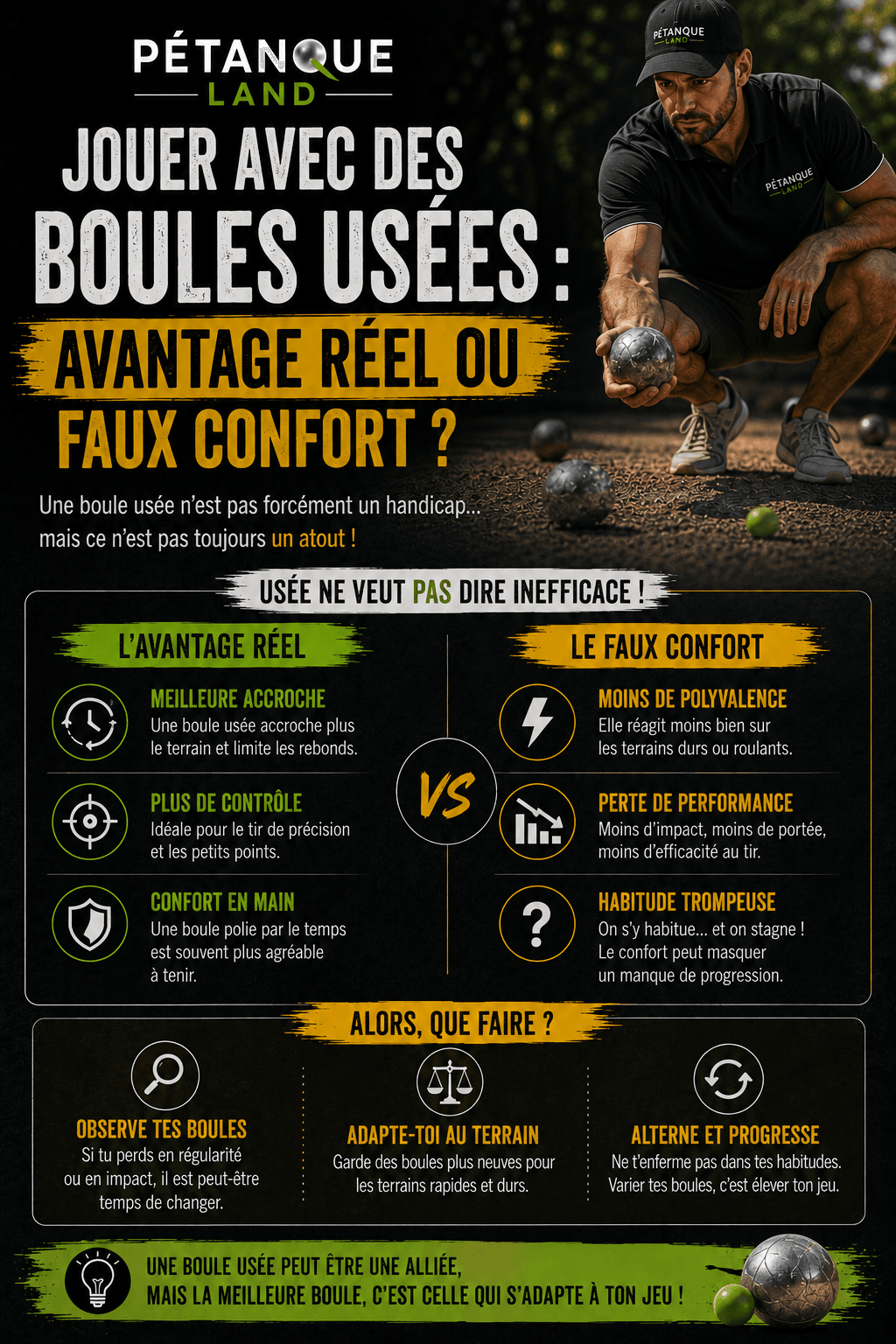
Playing with worn boules: real advantage or false comfort? (Pétanque)
There is a stubborn belief in the world of pétanque: old boules are better because they are “broken in”. The surface is soft, we know them, we trust them. This belief is psychologically real — and tactically misleading. The comfort of familiarity and the performance advantage are two separate things, and confusing them prevents you from making good decisions about your hardware. This article separates what is true from what is perception. 2questionslaThe "break-in" myth — what is true, what is not
The term "break-in" comes from the mechanical world, where it denotes the period during which an engine's parts bed into each other to reach their optimal performance. Applied to pétanque boules, it covers a much fuzzier reality — and often the opposite.
🎙️ Paquita on "broken in" boules "I regularly hear players say their old boules are better because they are broken in. When I ask them what they mean by that, they describe a smoother surface, less bounce, a more fluid roll. What they are describing is exactly the symptoms of a boule whose striation has disappeared and whose surface has smoothed. Less bounce because the striation no longer bites into the terrain — that's not an advantage, it's a loss of grip. And 'they roll better' often means 'they roll further than they should'. Break-in exists in people's heads. In the boules, it's wear that we've learned to accept." — Paquita 🔑The fundamental distinction: psychological break-in is real and has value — knowing the exact behaviour of your boules helps you calibrate each throw precisely. Physical break-in is largely a myth — a worn boule is not mechanically better than a new boule of the same model. It is different — and often less performant on objective criteria.
The real advantages vs the real losses of worn boules
😌 WHAT IS GENUINELY BETTERThese advantages are real — they have concrete value for the consistency of your game.
- Precise knowledge of behaviour: you know exactly how they bounce on this terrain, at this distance. This calibrated information takes time to build and has value.
- Confidence in the grip: the throwing routine is stable. No surprises in the fingers.
- No adaptation period: a new set takes 10 to 30 games. Old boules need no recalibration.
- Solid mental reference points: under pressure, confidence in your equipment reduces the cognitive load — you focus on the tactical decision, not on the boule's behaviour.
These degradations are measurable — they produce objectively worse results.
- Worn-away striation = less grip: the boule rolls further after impact. The player compensates unconsciously — which degrades reproducibility.
- Flats and deformations = irregular roll: the boule no longer rolls in a perfectly straight line. The deviations are unpredictable.
- Smoothed surface = variable behaviour depending on terrain: performed well on the usual terrain, behaves differently as soon as the ground changes.
- Loss of sphericity = asymmetric impact: a flattened contact point creates different bounces depending on the orientation — impossible to compensate for consistently.
The 5 stages of wear — where are your boules?
📊 WEAR TIMELINE — FROM NEW TO OUT OF SERVICE STAGE 1 NEW0–6 months Clean, deep grooving. Uniform satin surface. Behavior matching the manufacturer's specifications. Slight break-in period needed. OPTIMAL STAGE 2 BROKEN IN
6–18 months Grooving still functional, a few slightly rounded grooves. Surface slightly shiny in places. The best stage : known behavior + performance still intact. IDEAL STAGE 3 WORN
2–4 years Grooving visible but with rounded edges on the preferential contact zones. Slight loss of grip on hard terrain. The player often adjusts their technique without realizing it. MONITOR STAGE 4 FATIGUED
4–7 years Grooving partially worn away on the impact zones. A few visible flat spots. Shiny surface on the contact zones. Unpredictable roll on dry terrain. INTERVENTION STAGE 5 OUT OF SERVICE
7 years+ Grooving almost gone. Multiple flat spots. Sphericity compromised. The player compensates heavily and blames their errors on anything but the equipment. REPLACE
These stages are approximate benchmarks — wear depends on how often you play, the type of terrain and the hardness of the boules. An intensive shooter can reach stage 4 in 2 years. An occasional player may still have boules at stage 2 after 6 years.
The signs that wear exceeds the acceptable threshold
① The boule consistently rolls farther than before on the same terrain If you play regularly on the same terrain and your boules now overshoot the target where they used to stop — without any change to your technique — the grip has decreased. The likely cause: grooving partially worn away. This drift is progressive and sets in over months, making it hard to notice without an explicit comparison. → Test: compare the roll of your boules with those of another player on the same terrain. If yours consistently roll 20 to 30% farther for the same throw, the grooving is significantly more worn. ② Unexplained lateral deviations on flat terrain On flat, smooth terrain, a boule in good condition rolls in a straight line. Regular deviations in one direction signal a loss of sphericity. A flat spot of just 0.5 mm can create a visible deviation over 6 metres of roll. Since these deviations are often blamed on the terrain, they easily go unnoticed for a long time. → Test: gently roll the boule on flat tiling. A spherical boule rolls perfectly straight. Any deviation indicates a shape defect. ③ Clearly better performance on some terrains than others A very worn boule can still work on soft terrain that compensates for the lack of grooving — but performs poorly on hard terrain. This increased dependence on the type of terrain is a sign of advanced wear. → If your boules "work well" only on one specific terrain and behave poorly elsewhere, wear has turned them into unintentional specialist boules — suited to your usual terrain, poor everywhere else. ④ Unexplained inconsistency between boules of the same set The three boules of a set wear at different rates depending on their usual orientation on impact. If one of the three behaves differently from the other two, its wear is asymmetrical. Playing with three boules of different wear creates inconsistency in your game blamed on variations in concentration rather than the equipment. → Test: note the performance of each boule individually over a session. If one boule consistently produces different results from the other two, check its surface condition and sphericity separately. ⑤ A sudden realization after playing with new boules Often, borrowing a partner's recent boules reveals the state of your own. If switching to the new boules immediately produces a better result despite no adjustment, it's a strong signal that your usual boules have passed their optimal performance threshold. → This involuntary test is often the most revealing. Don't ignore it on the grounds that "new boules are different" — honestly analyze whether the results were better and why.How the player adapts unconsciously — and why it is a problem
🧠 UNCONSCIOUS ADAPTATION — THE MECHANISMAs the boules gradually degrade, the player imperceptibly adjusts their technique — throwing harder to compensate for the lack of grip, aiming slightly off to compensate for the drift, choosing a different height to limit the roll.
The problem:These compensations become the new "normal technique" — built on faulty equipment. When the player finally changes boules, their compensated technique produces incorrect results with the new boules.
Consequence: changing boules after long wear requires "unlearning" the compensations — which explains why the transition is often difficult even when the new boules are objectively better. ⚠️ THE MOST COMMON COMPENSATIONSThese behaviors are often invisible to the player themselves — only an attentive observer or a comparative test reveals them.
Common compensations:Increased throwing force, reduced height when pointing, aiming slightly off from a central target, systematically choosing to shoot on "difficult" distances with the worn boules.
Detection test: play 15 minutes with new boules of the same model. If the throws consistently miss to one side or in depth, that's the compensation showing up with correct equipment. 📈 WHY THIS FALSE COMFORT LASTS SO LONGThe degradation is so gradual that no single moment triggers the alarm. Over 3 years, the gap is huge but imperceptible week to week.
Confirmation bias:Good games confirm that the boules are good. Bad ones are blamed on technique, the terrain, concentration. The boules are never suspected.
The solution: don't wait to "feel" that the boules are worn. Apply a regular checking protocol independent of how things feel. 🔄 THE REAL COST OF FALSE COMFORTPlaying with boules past their wear threshold has a concrete cost: less accurate trajectories and — above all — a technique that warps around the faulty equipment.
The most underestimated cost:It isn't the immediate loss of accuracy. It's the long-term degradation of technique. A player who plays for 5 years with increasingly worn boules develops a compensated technique that's hard to correct.
The real question: "Is my current technique the technique I want to develop over the next 5 years — or is it adapted to faulty equipment?"The decision tree — keep, re-groove or replace?
🔀 DECISION GUIDE 3 questions to know what to do with your worn boules ① Is the grooving still functional? (clean edges, visible depth, no large smooth areas) YES — grooving correct The boules are in good physical condition. Keep using them — the comfort of familiarity is a real advantage here. Check every 6 months. NO — grooving worn away in places The boules have lost some of their grip. Consider re-grooving if the boules are of good quality. If the grooving is uniformly gone, replacement is more effective. ② Does the boule roll in a straight line on a flat surface? (roll test on tiling) YES — straight roll Sphericity is preserved. The boules can keep serving. Check every 6 months if use is intensive. NO — visible deviation Sphericity is compromised. Re-grooving doesn't solve this problem — a deformed boule stays deformed after re-grooving. Replacement is the only real solution. ③ Does playing with new boules of the same model immediately produce better results? NO — similar results Your worn boules perform just as well. Keeping them is rational — the comfort of familiarity brings a net positive value. Check their condition every 6 to 12 months. YES — new boules clearly better Wear has passed the threshold where familiarity compensates. The change is objectively justified. Plan an adjustment period of 10 to 20 games with the new boules.Table: symptom → cause → action
| Observed symptom | Likely cause | Stage | Recommended action |
|---|---|---|---|
| Boules roll 20–30% farther than before | Grooving partially worn away — reduced friction | Stage 3–4 | Comparative test with new boules, consider re-grooving |
| Regular lateral deviation on a flat surface | Loss of sphericity — local flat spots | Stage 4–5 | Replacement — re-grooving doesn't correct the shape |
| One boule of the set behaves differently from the other two | Asymmetrical wear — preferential contact zones | Stage 3–4 | Check individually, consider replacing the whole set |
| Good performance only on the usual terrain | Boule calibrated to one terrain through selective wear | Stage 3–4 | Acceptable for local play, a problem for competitions on varied terrains |
| Lower and less lively bounces | Grooving worn away — less energy returned | Stage 2–3 | Monitor — may be perceived positively but signals progressive wear |
| New boules tested = better immediate results | Wear past the compensation threshold | Stage 4–5 | Change — plan an adjustment period of 15 to 20 games |
| Compensated technique revealed by new boules | Long-term adaptation to degraded equipment | Stage 4–5 | Change the boules AND work on the technique without compensation |
| Grooving visible but slightly rounded | Normal wear, still working well | Stage 2 | Keep — this is the ideal stage for most players |
The question isn't "do I like my old boules?" — obviously yes. The question is: "Is my current technique suited to boules in good condition, or is it suited to worn boules?" If the honest answer is the second option, keeping the old boules maintains comfort but degrades your technique over the long term. The right time to change is when your game is still good — not when it has deteriorated to the point of being forced to.
Exercises to objectively evaluate your boules
01 The blind test — objective comparison 📍 Usual terrain ⏱️ 30 min 🎯 Measure the real gap between worn and new boulesEliminate the psychological bias of familiarity with a structured comparative test — the most honest way to assess your boules.
Borrow a set of recent boules (less than 2 years old, visible grooving) with the same profile as yours. Ask your partner to mix them and hand them to you alternately without telling you which is which — neither yours nor the new ones. The goal is not to know during the throws. Play 30 pointing throws at the same distance. After each throw, mentally note whether the result was satisfactory (in the target zone) or not. The point is to collect data without confirmation bias. After the 30 throws, ask your partner to reveal which were yours and which were the new ones. Compare the results. If the new boules produced more satisfactory throws — even slightly — wear has an objective impact on your performance. If the results are nearly identical: your boules are still functional and your knowledge of their behavior protects you. Keeping them is rational. If the new boules are clearly better in the blind test: the decision to re-groove or change is justified by the data, not by an opinion. 02 The transition protocol — changing without losing everything 📍 Training over several sessions ⏱️ 3 to 6 weeks 🎯 Integrate new boules without degrading your gameA well-managed change of boules avoids the "performance crisis" many players go through after changing equipment.
Weeks 1–2: mixed play. Play every session with the new boules in training only — keep the old ones for important games. The goal is to build the first reference points without result pressure. Weeks 2–3: active calibration. For each usual type of throw, play 10 consecutive boules and note the adjustment needed. State these adjustments explicitly — "the new boules stop 30 cm earlier at 8 metres" — rather than leaving it implicit. Weeks 3–5: gradual transition. Start using the new boules in normal games. Accept a slight drop in performance for 2 to 3 weeks. Do not revert to the old ones at the first sign of difficulty, except for truly important games. Week 5–6: assessment. Assess whether your game has returned to its usual level. Most players find they return to their level within 4 to 6 weeks. If your level does not return after 6 weeks, check that the profile of the new boules actually matches your usual terrain — a profile error is more common than simply insufficient adaptation. 🔧 PREVENTIVE MAINTENANCE — SLOWING DOWN WEAR What you can do to extend the life of your boules Clean the grooves after each session BASIC MAINTENANCE — Soil particles that lodge in the grooves accelerate their wear through abrasion. Cleaning with water and a soft brush keeps the grooves clean and slows their filling. Do not store the boules in direct contact STORAGE — Micro-impacts between boules during transport create microscopic flat spots. Use a bag with individual compartments or a soft pouch. Avoid highly abrasive terrains with your best boules ADAPTED USAGE — Some terrains (angular gravel, rough concrete) wear boules 3 to 5 times faster. If you play regularly on these terrains, consider a separate "difficult terrain" set of boules. Monitor their condition at least every 12 months CHECK — A rolling test on a flat surface and a visual inspection of the grooving once a year. These 10 annual minutes save you from discovering advanced wear only after your game has started to deteriorate.FAQ — Your frequent questions
Is restriping worth the cost, or might as well buy new balls?+ The answer depends on the initial quality of the balls. For entry-level boules (€50–80), restriping is proportionately expensive — buying new can be more economical. For higher quality boules (€150–300), restriping (often €30 to €50 per set) is clearly more profitable and allows you to preserve steel whose behavior is known. The condition: sphericity must be preserved — a deformed ball remains deformed after restriping. My balls are 10 years old but I play very little. Are they still worn out?+ Wear depends on the number of impacts and the type of terrain, not the weather itself. Balls used 10 times a year for 10 years may be in better condition than balls used 200 times in 2 years of intensive practice. The physical test takes precedence over age: check the groove visually and test rolling on a flat surface. In contrast, some steels oxidize lightly over time — light surface rust can be cleaned off, but deep rust changes the surface and adhesion. Can you restrip your balls yourself?+ Technically possible but strongly discouraged. Professional restriping is done on a precision lathe which ensures that the ridges are regular, at the correct depth, and that the sphericity is not affected. Amateur restriping often produces irregular streaks that create unpredictable behavior — worse than worn streaks. Some manufacturers offer restriping by sending the balls by mail — this is the recommended solution for quality balls. How to approach a competition when you have just changed balls recently?+ If the change is less than 4 weeks old, the new balls are not yet fully integrated — prudence recommends keeping the old ones for an important competition if they are still functional. If the change is 4 to 8 weeks old and the adaptation has gone well, the new balls can be used. If the old balls are in poor condition (stage 4–5) and the contest lasts several hours, the new balls are probably the best choice despite the incomplete adaptation — the wear and tear of the old balls will create more problems over time than the adaptation to the new ones. 📎 Related articles EquipmentWhy some boules "grip" the terrain better EquipmentBowl diameter: why the wrong choice penalises you PhysicsWhy some boules leave the game for no apparent reason TerrainAdapting your play to an uneven terrain EquipmentChoose your boules according to your level and style ToolsFree PetanqueLand tools© Pétanque by Paquita — petanqueland.fr · 📖 Paquita's book on Amazon