Actualités · 12 March 2026
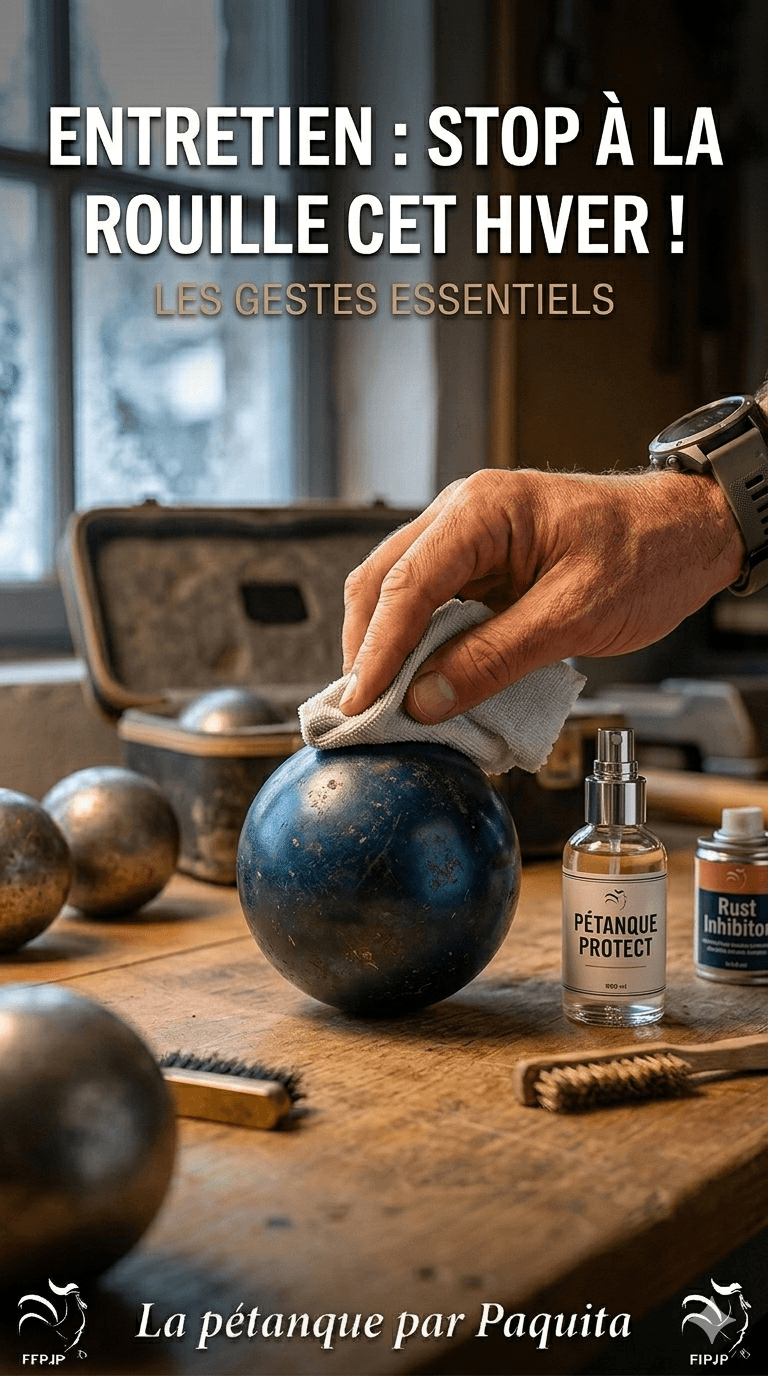
Care: stopping your boules from rusting over the winter
Storage, cleaning, oiling, putting away... Paquita gives you the complete protocol so your pétanque boules come out spotless in the spring, without a trace of rust.Why bowls rust — the chemistry in 2 minutes
Rust isn't an accident. It's an unavoidable chemical reaction as soon as three ingredients come together in the same place. Understanding that means understanding why each step of the maintenance routine is useful — not just some old player's ritual.
⚗️ THE OXIDATION REACTION OF IRON ⚙️ STEEL(iron + carbon) + 💧 MOISTURE
(water + air) + ⏱️ TIME
(weeks) → 🟫 RUST
(iron oxide) Remove one of the three ingredients → no rust. Winter maintenance aims to remove moisture from contact with the steel.
- 💧Moisture is the main enemy — a wet terrain, rain during a game, condensation in the bag: every contact with water leaves a film that triggers oxidation. In winter, the ambient humidity of an unheated garage or cellar is enough.
- 🧂Salt speeds everything up — games on wet terrains or by the seaside leave salt deposits on the bowls. Salt is an extremely effective rust catalyst. Never put bowls away without drying them after a game in the rain or on a wet terrain.
- 🌡️Thermal shocks create micro-cracks — repeated cold/hot swings (unheated garage at night, heated car by day) expand and contract the metal. These micro-cracks are invisible to the naked eye but give moisture extra entry points.
- 🔬Surface rust isn't the same as deep rust — superficial rust (a light brown film) is easy to treat. Rust that has penetrated the steel (pitting, craters) is irreversible and can affect the approval of the bowls. That's why preventive maintenance is infinitely better than curative treatment.
Stainless steel, carbon steel, bronze: which rusts the most?
Not all bowls have the same resistance to oxidation. The composition of the steel makes a real difference — and determines how much maintenance is needed.
✨ Stainless steel (Inox) Rust risk: LowStainless steel contains chromium, which forms a natural anti-oxidation passive layer. It can still rust in extreme cases (salt water, long-term damp storage). Light maintenance is sufficient.
⚙️ Carbon steel (soft / hard) Rust risk: HighCarbon steel has no natural protective layer. It's the material most prone to rust — and the most common in entry-level and mid-range bowls. Rigorous maintenance is essential in winter.
🥉 Bronze (alternative material) Rust risk: Very lowBronze is a copper-tin alloy that's naturally resistant to corrosion. Rare in pétanque, used on specific models. Minimal maintenance — but bronze can tarnish and requires occasional polishing.
🔍To find out whether your bowls are stainless or carbon steel: look at the marking on the bowl (often "acier inoxydable", "stainless steel", or the FFPJP approval number that refers to the technical sheet). In case of doubt, bring a magnet close: stainless steel is weakly magnetic, carbon steel is strongly magnetic.
The winter storage routine — step by step
This routine is done once at the end of the season — usually in October or November, after the last game. It takes about 30 minutes for a full triplet (6 bowls).
Cleaning with lukewarm water and mild soapScrub each bowl with a non-abrasive sponge, lukewarm water and Marseille soap or washing-up liquid. The aim: remove dried mud, salt deposits and terrain residue. Do not use acidic products or steel wool at this stage.
Sponge + mild soap 5 min per triplet Complete drying — this is the most critical stepWipe immediately with a dry, absorbent cloth. Leave to air-dry for 30 to 60 minutes in a dry, ventilated place before continuing. A damp oiled bowl traps moisture under the oil — exactly the opposite of the desired effect.
30–60 min air drying Critical step — don't skip it Visual inspection — detect existing rustUnder good lighting, inspect the entire surface of each bowl. Look for: brown-orange spots (superficial rust), small pits (penetrating rust), dull grey areas (early oxidation). The areas to treat will be addressed in step 5 before oiling.
Direct light or lamp Treating superficial rust (if necessary)If light spots are present: rub with fine steel wool (000 or 0000) or 400-600 grit abrasive paper, in gentle circular motions. Rinse, dry completely again before moving on to the next step. This step is pointless on bowls with no rust.
000 steel wool or 400+ paper Only if rust is present Applying the protective oilApply a thin layer of protective oil over the entire surface of each bowl with a clean cloth. The oil creates a barrier between the metal and ambient moisture. Less is more: a thin, even coat is better than a thick one that makes your hands greasy.
Light mineral oil or WD-40 2–3 min per triplet Storage in the right container, in the right placeStore the bowls in their original bag, box or case — avoiding airtight plastic bags that trap residual moisture. Store indoors or in a dry place at a stable temperature. See the storage section for details.
Open bag or original case 🎙️ Paquita on the classic mistake "The first year I looked after my bowls, I made the classic mistake: I oiled them without drying them thoroughly. Result in spring: a lovely brown layer of oil with rust underneath. The oil had trapped the residual moisture against the metal all winter long. Since then, complete drying before oiling is an absolute rule." — Paquita, a lesson learned the hard wayWhich products to use (and which to avoid)
| Product | Use | Effectiveness | Verdict |
|---|---|---|---|
| Paraffin oil / light mineral oil | Preventive protection | Excellent — long-lasting thin coat | ⭐ Ideal |
| WD-40 (multi-purpose lubricant) | Protection + light rust removal | Good — drives out moisture effectively | ✓ Very good |
| Boiled linseed oil | Long-lasting protection | Excellent — polymerises on the metal | ⭐ Ideal for carbon steel |
| Light engine oil (e.g. 5W30) | Emergency protection | Decent — but thick, makes hands greasy | ⚠ Stopgap |
| Olive oil / vegetable oils | Avoid | Goes rancid over time, attracts insects | ✗ Not recommended |
| Hydrochloric acid / paint strippers | Aggressive rust removal | Effective but attacks the surface | ✗ Approval at risk |
| Car polish compound (e.g. T-Cut) | Polishing + light protection | Good on light superficial rust | ✓ Useful as a finish |
| Bicarbonate + white vinegar | Natural rust removal | Light rust only — test on a small area first | ⚠ Gentle but slow |
Using aggressive acidic products (hydrochloric acid, industrial chemical strippers) can alter the diameter or surface hardness of a bowl and make its marking illegible. A bowl whose approval number is no longer visible may be refused by an umpire in an official competition. In case of severe rust, prefer a gentle mechanical treatment (fine steel wool) over an aggressive chemical treatment.
Ideal storage: place, temperature, container
✅ Where and how to store- Inside the house — stable temperature
- Cupboard, wardrobe, shelf sheltered from moisture
- Original case with foam — keeps the bowls separate
- Open bag or bag with the zip partly open
- Ventilated place — air circulates slightly
- Bowls wrapped individually in a dry cloth
- Temperature between 10°C and 20°C — stable
- Unheated garage with large temperature swings
- Damp cellar with no ventilation
- Airtight sealed plastic bag (traps moisture)
- Bowls stacked with no protection between them
- Car boot in winter (condensation + cold)
- Direct contact with a cold concrete or tiled floor
- Near a sink, washbasin or damp area
If you don't have the original case: wrap each bowl in an old dry cotton sock before putting them in the bag. The cotton absorbs residual moisture, avoids knocks between bowls (which create tiny scratches where rust takes hold), and the bag can stay closed without risk. Simple, free, and remarkably effective.
Treating existing rust
You take the bowls out in spring and the rust is there. Don't panic — depending on the stage, a curative treatment can restore a flawless surface. The earlier you catch the rust, the simpler the treatment.
🟡 Very light rust — superficial filmRub with a cloth lightly soaked in WD-40. The rusty film comes off in 2 minutes. Rinse, dry, oil. No visible mark after treatment.
Effectiveness: ★★★★★ — Damage: none 🟠 Moderate rust — clearly visible spotsVery fine steel wool (000 or 0000) in regular circular motions. Rinse with water, dry perfectly, then apply linseed oil or WD-40. The surface will be slightly matt but clean.
Effectiveness: ★★★★☆ — Damage: very low 🔴 Severe rust — deep pitting220 then 400 then 600 grit abrasive paper (working from coarser to finer). Long and tedious. The surface will be altered. It may affect the look of the engravings. Check the approval afterwards.
Effectiveness: ★★★☆☆ — Damage: moderate ⚫ Deep rust — eaten-away metalPenetrating rust has created irreversible cavities in the steel. No surface treatment can restore the original geometry. These bowls can no longer be used in official competition — only for friendly play.
Treatment: none — consider replacing them 🥤 Coca-Cola — myth or reality?Have you heard that Coca-Cola removes rust? It's partly true: the phosphoric acid in soft drinks attacks iron oxide. In practice on bowls: effective on very light rust, harmless to the metal if contact is kept short (15–20 minutes). Rinse thoroughly afterwards, dry, oil. It's not the best tool available — but it's better than nothing if you have nothing else to hand.
The maintenance schedule across the whole season
🌸 Spring 🔄 Inspect when taking them out of storage. Wipe off excess oil with a cloth before playing. Check the condition of the engravings. ☀️ Summer 🧹 After every game in the rain or on a wet terrain: dry the bowls before putting them in the bag. Avoid airtight bags in full sun (condensation). 🍂 Autumn 🛡️ Full winter storage routine: cleaning, drying, inspection, rust treatment if needed, oiling, winter storage. The critical season. ❄️ Winter 😴 The bowls are stored correctly — nothing to do. Check once in January if stored somewhere with significant humidity variations. 📅The golden rule: never to put damp bowls away. Whether after a game in the rain in August or before winter storage in October, a damp bowl put away in a closed bag is a bowl that will rust. Five minutes of drying when you leave the terrain saves hours of treatment in spring.
FAQ — Your frequent questions
My balls are stainless steel — do I still need to maintain them? + Yes, although the maintenance is much lighter. Stainless steel resists rust thanks to a passive layer of oxidized chromium, but this layer can be damaged by repeated impacts, scratches or prolonged contact with salt water. Cleaning + drying + light protective oil in autumn is still recommended, especially if the balls are stored in a place with variations in humidity. Stainless steel can rust — it’s just slower. Will rust on my balls affect competition approval? + It depends on the stage of the rust. Cosmetic surface rust (light brown film) does not affect the regulation dimensions and should not be a problem. On the other hand, rust which has made the approval engravings (FIPJP number, weight, diameter) illegible can be a cause for refusal by an arbitrator — the obligatory marks must remain clearly visible. Deep rust which has modified the diameter or sphericity of the ball is also a potential cause of invalidation. See our article on the approval of FFPJP bowls. Can you use anti-rust spray paint on pétanque balls? + No. Anti-rust paints modify the diameter of the balls (even slightly) and their surface appearance, which may invalidate the approval. They also modify the surface roughness and therefore the behavior of the ball on the field. Maintenance of pétanque balls involves exclusively oils and mild mechanical abrasives — never using coatings that alter the surface. What is the difference between steel wool and sandpaper for treating rust? + Steel wool (also called steel wool) is more flexible and softer than sandpaper. It follows the curvature of the ball naturally and leaves fewer directional stripes. Grades 000 and 0000 are the finest and least aggressive. Sandpaper is more directive and leaves visible streaks if you don't pay attention to the direction of friction. In practice: for light to moderate rust, fine steel wool is preferable. For severe rust, sandpaper (start with 220 grit, finish at 600) works best. How long will my balls last with proper maintenance? + Properly maintained balls last for decades. The main material (steel) doesn't really wear out with normal play — what destroys them is untreated rust and very violent impacts (repeated iron shots). Players have been using the same balls for 20 or 30 years with regular maintenance. The regulatory wear to watch out for is the diameter: a mechanically worn ball can fall outside of FIPJP tolerances (70–80 mm), but this is very rare in normal play. Should I also maintain the boxwood jack? + Yes, but differently. Boxwood does not rust, but it dries, cracks, and can warp with humidity. For the winter: store it in a dry and stable place (neither too humid nor too dry). Do not oil it with mineral oil (it penetrates the wood). Linseed oil is suitable for wood if you want to lightly nourish it. Absolutely avoid damp cellars and garages. A well-stored jack stays round and in weight for years. See our article on the carbon vs boxwood jack for more details on the materials. 📎 Related articles Equipment Stainless steel vs carbon boules — full comparison Equipment How to check the FFPJP approval of your boules? Equipment Choosing your pétanque bowls for the 2026 season Equipment Top 3 best shooter boules 2026 Video Why changing bowls does not change your level Tools Free tools for pétanque players© Pétanque by Paquita — petanqueland.fr
Practical guide based on the properties of common steel alloys. In case of doubt about the approval of your bowls after treatment, contact your departmental FFPJP committee.