Actualités · 16 April 2026
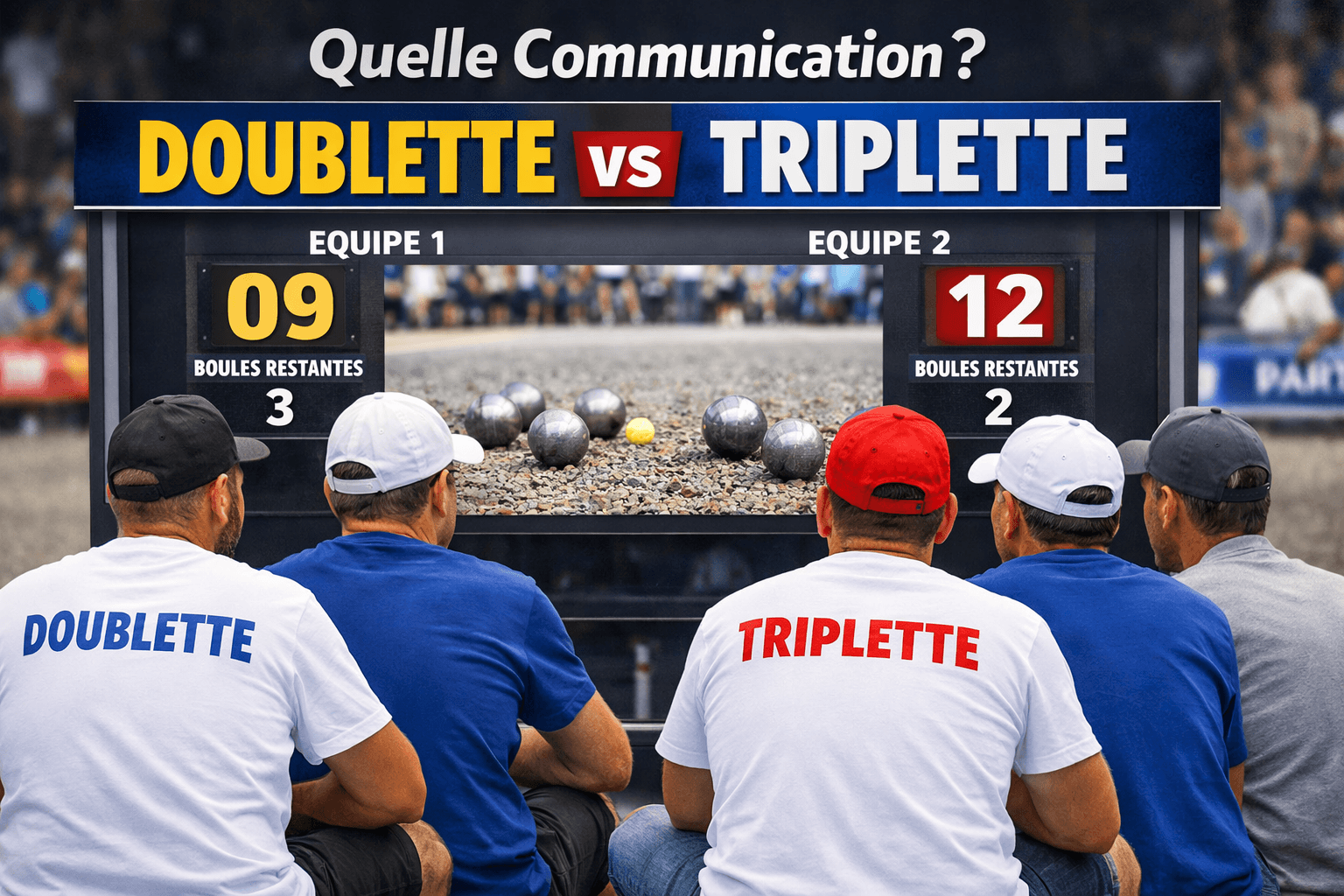
Doublette vs Triplette: What communication?
In doublette you manage everything with a single partner. In triplette you navigate between three egos, three readings of the game and three personalities. Communication changes radically depending on the format. Paquita breaks down both dynamics.The fundamentals of communication in pétanque
Before distinguishing doublette and triplette, a few principles apply to both formats.
👑 A single decision-maker per bouleThe final decision on each boule belongs to a single person — either the player who plays it or the captain. Two contradictory voices on the same boule create confusion and destabilise the thrower.
🔇 Silence during executionOnce the decision is made and the player is in the throwing phase, teammates stay quiet. Any words during the backswing — even encouraging — disrupt concentration. Encouragement comes before or after, never during.
⏱️ Decision before the circleThe player must know what they are doing before stepping into the circle. Hesitation in the circle is visible, is felt and alters the motion. Communication stops when the player enters the circle.
🎯 Factual feedback, not emotional"Your boule is 30 cm to the left of the jack" is useful feedback. "That was rubbish" is destructive. After each boule, the immediate feedback is factual and correction-oriented — never a value judgement.
📋 Conventions set in advanceSome recurring communications must be codified before the tournament — "if I want to shoot while I'm pointing, I say shoot" or "the captain speaks only if the situation is ambiguous". These conventions reduce the communication needed during the game.
🌡️ Adapt to the player's stateA stressed player needs short, reassuring communication. A confident player can receive more tactical information. Reading the mental state of your partner/teammate is part of non-verbal communication.
🔵 Communication in a doublette
👥 DOUBLETTE — Tactical intimacy 2 players, 3 boules each — everything is shared between the two THE TWO-PERSON DYNAMIC In a doublette, the closeness between the two players is at its maximum. There is no intermediary — every decision is discussed or at least shared between the two people. This closeness is a strength (quick alignment, complicity) and a fragility (tensions spread instantly). A single disagreement poorly managed in a doublette affects both players for the rest of the game. FREQUENCY AND NATURE OF COMMUNICATION Communication in a doublette is naturally more frequent and more symmetrical than in a triplette. The two players have overlapping roles — each is able to point AND shoot depending on the situation. They negotiate more on decisions — "are you shooting or am I?", "I point and you keep your boule?" — and this negotiation creates cohesion if it is quick, or confusion if it drags on. MANAGING DISAGREEMENTS In a doublette, the two players often have slightly different readings of the same situation. The golden rule: the player who plays the boule has the last word — their partner gives their opinion but does not impose it. After the boule is played, no comment on the decision made — only on the result and what to do next. NON-VERBAL COMMUNICATION In a long-standing doublette, a lot of communication passes through looks, gestures, posture. A player who sighs after their partner's boule communicates a criticism without words. A player who is already positioning themselves near the circle signals their confidence in the decision. Non-communication is itself a communication — managing your body language is part of the game. THE DOUBLETTE RULE — In the event of a disagreement, the decision belongs to the player who plays. In the event of a persistent disagreement over the overall strategy, it's the score that settles it: if it works, we continue; if it doesn't, we listen to the other proposal. 💬 TYPICAL DIALOGUE — EFFECTIVE DOUBLETTE (vs DYSFUNCTIONAL DOUBLETTE) Situation: opponent holding at 8 cm, you at 15 cm. Score 7–6. PLAYER A"I'll shoot their boule, you point afterwards if I miss." PLAYER B"OK go for it. If you miss, I've still got two boules." → Effective communication: clear decision, defined roles, 5 seconds Same situation, dysfunctional doublette: PLAYER A"Do you want me to shoot or would you rather point?" PLAYER B"Well... do what you want. You normally shoot better." PLAYER A"Yeah but if I miss we're in trouble. You've got two boules left." PLAYER B"Point then. No, shoot. Well... make your mind up." → Dysfunction: shared indecision, pressure on the thrower, 45 seconds lost🔴 Communication in a triplette
👥 TRIPLETTE — The necessary hierarchy 3 players, 2 boules each — the captain's voice prevails HIERARCHY AS A TOOL In a triplette, a clear hierarchical structure is not a sign of authoritarianism — it is a functional necessity. Three people cannot make a collective decision in 20 seconds without a designated leader. The captain doesn't necessarily decide better than the others — they decide faster, which is often more important. THE SILENCE OF THE OTHER TWO In a triplette, the hardest rule to hold is this one: when the third player is in the circle, the other two stay quiet. No "go on", no "shoot their boule", no "careful on the terrain". Nothing. Three different voices during a throw create confusion, not help. The only one to speak is the player themselves or the captain — and only before the throw. INTER-END COMMUNICATION The richest moment of communication in a triplette is between the ends — not during them. This is when the captain shares their reading, when the players give their opinion on the strategy, when the adjustments are decided. Using these 2–3 minutes of transition to align everyone avoids improvised emergency communication during the next end. MANAGING THE THREE EGOS Three players = three readings of the game = three opinions on every situation. The captain must hear these opinions (so as not to miss a good observation) without letting themselves be drowned in them. The method: the captain listens to one observation per player at most before deciding — not a debate. If two players have two opposing views, the captain settles it. End of subject. THE TRIPLETTE RULE — A single voice during throws: the captain. The other two may speak only between boules. The captain can ask for an opinion ("would you shoot there?") — but no one gives an opinion without being asked. 💬 TYPICAL DIALOGUE — ORGANISED TRIPLETTE (vs CACOPHONIOUS TRIPLETTE) Situation: the pointer has just left the opponent holding. Middle player's turn. CAPTAIN"Middle — shoot their boule. Clear position, correct angle." MIDDLE"OK I'll take it." [Silence from the other two during the throw] → Organised triplette: a single voice, clear decision, silent execution Same situation, cacophonous triplette: SHOOTER"Shoot their boule! Don't leave that!" POINTER"No, point in front, you'll miss!" CAPTAIN"Wait, think about what you're going to do..." → Cacophony: 3 contradictory voices, middle player paralysed, maximum pressure 🎙️ Paquita on communication in a triplette "I played in a triplette where all three players expressed themselves on every boule. We all had an opinion, we were all convinced we were right. We lost tournaments we should have won, not because of our technical level but because of the noise we created around every boule. The end when we realised it: the middle player took their boule, all three of us fell silent for the first time that day, and they placed a perfect carreau. Afterwards the shooter said 'did you hear the silence?' We adopted the silence rule immediately." — PaquitaFull comparison: doublette vs triplette
| Dimension | 🔵 Doublette | 🔴 Triplette |
|---|---|---|
| Communication frequency | High — both speak often | Selective — mainly between ends |
| Symmetry of decisions | More symmetrical — both have a say | Hierarchical — the captain decides |
| Main risks | Shared indecision, emotional contagion | Cacophony, under-communication from the captain |
| Silence during throws | Recommended but harder to maintain | Mandatory — non-negotiable rule |
| Captain's role | Less formal — either can be it | Formal and clear — a single person |
| Managing disagreements | The throwing player has the last word | The captain settles it — no debate |
| Key communication moment | Before each boule (quick) | Between ends (longer) |
| Impact of a conflict on the game | Immediate and direct — both are affected | Diffuse but toxic — undermines the group over time |
| Feedback after a bad boule | Direct between partners — to be dosed | Goes through the captain — no direct comment between players |
| Non-verbal communication | Very present — the two know each other well | Present but more complex — 3 people to read |
The 8 most frequent communication errors
DOUBLETTE Hesitating out loud in front of your partner In a doublette, verbalising your hesitation ("I don't know whether to shoot or point...") contaminates your partner with your own doubt. The hesitation exists — you manage it mentally, in silence, before entering the circle. ✓ Decide before communicating. Say only the final decision, not the hesitation process. DOUBLETTE Criticising your partner's boule immediately after the throw The boule has just landed 40 cm away — "you should have pointed" or a simple visible sigh. The partner hears it, feels it, and carries that comment into their next boules. Post-boule criticism changes nothing about the result and alters the mental state. ✓ Feedback only on what helps for what follows — never on what can no longer change. TRIPLETTE Three simultaneous voices before the middle player's or shooter's boule The player enters the circle and hears three contradictory pieces of advice. They try to take in all of them, take in none of them properly, and throw with divided concentration. This is the most frequent source of a failed throw in a triplette. ✓ Captain-only rule. The other two express their opinion BEFORE the captain gives their instruction — and then silence. TRIPLETTE The captain who doesn't communicate at all The other extreme: a captain who assumes that "the players know what to do". In a triplette, tactical ambiguities are numerous — without instruction from the captain, the players hesitate, improvise each on their own, and create strategic inconsistencies. ✓ The captain says something before every boule — even if it's just "do what you feel, the situation is clear". A silent captain is as problematic as an over-talkative captain. DOUBLETTE Encouragement during the backswing "Go on!" or "Come on!" while the partner is swinging their boule. The intention is good — the effect is negative. Any external stimulus during execution disrupts the neuromotor circuit of the motion. Encouragement comes before ("you're going to make it") or after ("nice boule"). ✓ Absolute silence between the start of the backswing and the landing of the boule. Without exception. TRIPLETTE Recriminations after a lost end The end has just been lost — someone says "if you hadn't missed your shot..." or "I said to point...". These recriminations poison the next end for the whole team. The targeted player goes into the next end with extra mental load. ✓ Strict rule: zero recrimination about past boules during the game. Collective analysis happens after the tournament, not during. DOUBLETTE Not communicating at all when things are going badly After several lost ends, one of the players closes up — no more looks, no more words, minimal communication. This communicative silence sends a very strong message to the partner: "I'm blaming you for this". The absence of communication is sometimes more toxic than poor communication. ✓ Maintain a minimum of positive communication even in the difficult phases — "we start again", "it'll be fine", "we play the next one". Short, positive, forward-looking. TRIPLETTE The captaincy debate during an end Two players start debating strategy while a boule is about to be played. This kind of discussion, even silent if it is resolved in looks and shrugs, is visible to everyone — and destabilises the player who has to throw. ✓ All strategy debates take place between ends. During the end, only one voice allowed — the captain's.The communication rules to set before the tournament
The best teams define a few simple communication rules before playing — not a full manual, just the points most likely to create tensions. These shared conventions save time and avoid friction.
🤝 In a doublette — who has the last word"The player who plays the boule decides — the other gives their opinion if asked." This simple rule avoids 80% of decision conflicts in a doublette.
👑 In a triplette — who is captainDesignate the captain BEFORE the first game. Do not change them during the tournament unless everyone agrees. Instability in the captaincy is the main source of disorganisation in a triplette.
🔇 The silence rule"Complete silence between the start of the backswing and the landing of the boule." To be agreed verbally with all the players before the first match. "Are we agreed that no one speaks while we're throwing?"
🚫 Zero recrimination during play"We don't analyse errors during the game — only afterwards." Everyone has to buy into this rule explicitly — otherwise the first recrimination after an error becomes an unforeseen wound.
📞 In a doublette — opinion signalAgree on a short phrase to ask your partner's opinion: "What do you see?" means "give me your reading in one sentence". Otherwise, you make your decision alone. Avoids unsolicited communication.
📢 In a triplette — when the others may speakDefine when non-captains may speak: "only if the captain asks" or "freely between boules but not during". Clarify this boundary before the tournament.
Managing communication under pressure — close score
⚡Communication always degrades under pressure — it is a documented physiological phenomenon. When the score is close and the stakes are at their maximum, cortisol and adrenaline reduce the capacity to process information and increase emotional reactivity. Communication becomes shorter, more directive, sometimes aggressive — even in usually calm players. Knowing that this degradation is coming allows you to compensate for it deliberately.
🧘 The 5-word rule under pressureIn a situation of maximum pressure (game-winning boule, score 12–12, final), simplify communication to 5 words or fewer. "Point in front, let's be careful." "Shoot — clear situation." "Play your boule, trust yourself." Long analyses under heavy pressure are not processed correctly by the stressed brain — they add cognitive load with no tactical benefit. Short, clear, confident.
📖 PAQUITA'S BOOK Technique, tactics and team communicationRoles in a triplette, communication under pressure, score management, real-time reading of the game... Paquita's book covers every dimension of team play with 100 numbered exercises.
📦 Order on AmazonFAQ — Your frequent questions
In doubles, do you really need a designated captain or are the two players equal? + In theory, the two doubles players have equivalent statuses and can share decisions. In practice, even in doubles, it is useful for one player to have the informal role of "final decision maker" when the two disagree. This role can alternate between the two players (one is captain in the first half, the other in the second half) or be fixed on the player with the best tactical reading. The total absence of a decision-making structure creates blocking situations at key moments — an informal sign of leadership is enough, no need for a formal designation. How to deal with a teammate who does not respect the rule of silence during throws? + Two approaches. 1) Direct conversation off the field — "I noticed you talk during my throws, it really distracts me. Can we stick to the rule of silence?" This calm conversation outside the emotional context of the game is the most effective. 2) During the game, if the situation arises: raise your hand discreetly in the “stop” gesture before entering the circle — visual signal agreed in advance. Avoid verbal reproach during the game which creates tension that everyone feels. Can we change captain during the competition if it doesn't work? + Yes, but with caution. A change of captain during a contest signals a crisis — and a crisis visible to the opponent can further destabilize the team. If the change is necessary, do it between two games (not between two ends) and announce it clearly to the whole team: "we'll try with X as captain for the next game". Never take away the captaincy from someone during a match — it's a public humiliation that permanently damages trust. How to deal with an experienced player playing with two beginners in triplets? + This situation calls for educational rather than strategic communication. The experienced player naturally becomes captain — but he must adapt his tactical vocabulary to the beginner level. Avoid overly technical terms, prefer simple visual instructions ("point right there, next to the cork"), and celebrate each good action of beginners more than criticize mistakes. Competitive educational communication is an art — too much instruction kills confidence, too little leaves beginners lost. 📎 Related articles Rules The one-minute rule — deciding within the allotted time Rules FFPJP rules — roles and responsibilities in a team Equipment Choosing your boules — adapting to your role Equipment Top 3 best shooter boules 2026 Tournaments Official 2026 tournament calendar Tools Free PetanqueLand tools© Pétanque by Paquita — petanqueland.fr · 📖 Paquita's book on Amazon