Règlement FFPJP · 11 July 2026
What are the official dimensions of a pétanque court?
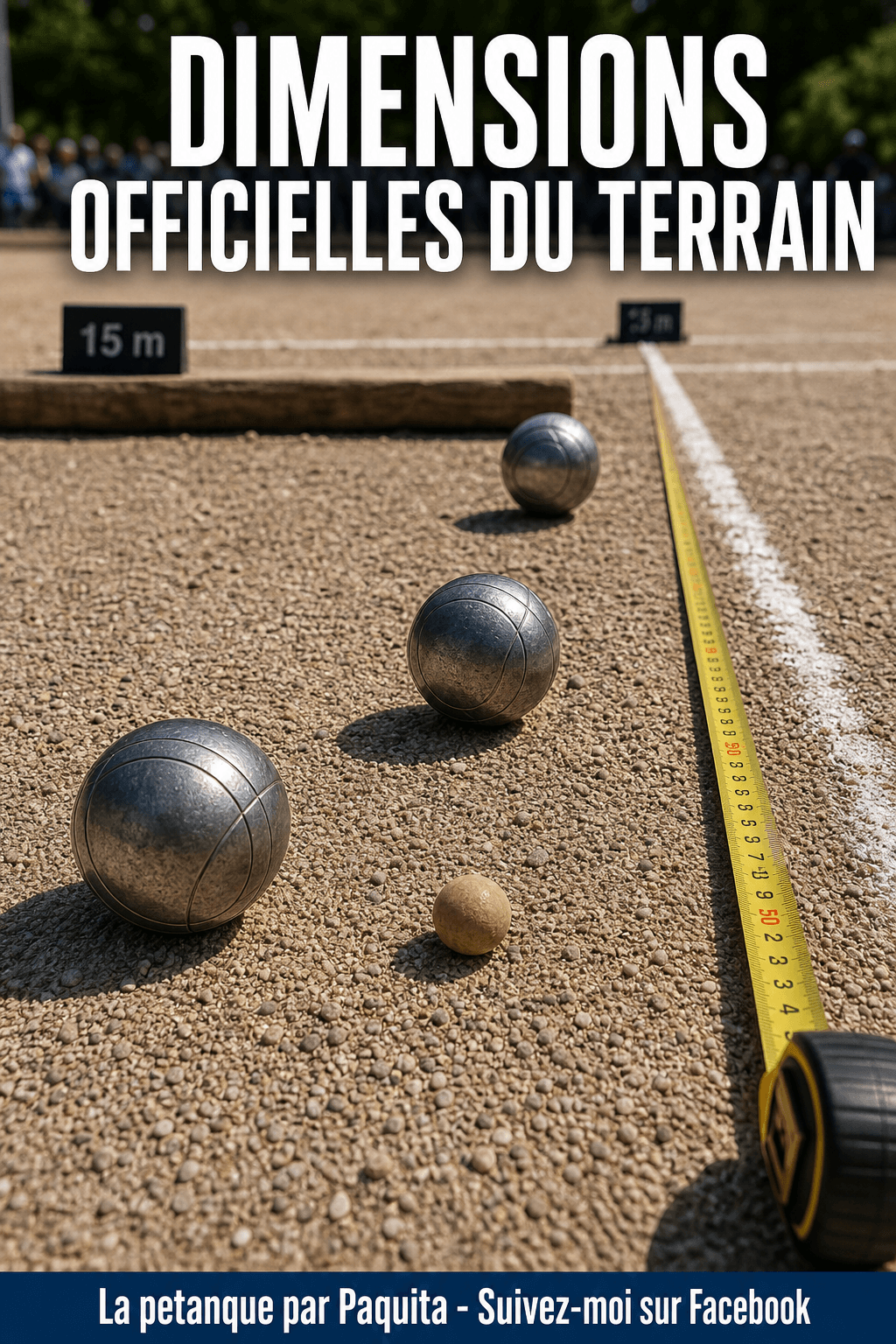
Official dimensions of a pétanque terrain: width, length, tolerances, competitions, marked or open terrain. The rule explained simply.1.The official reference dimension: 15 m x 4 m
The reference pétanque terrain measures 15 meters long by 4 meters wide. This format offers enough depth to play the regulation jack between 6 and 10 meters, keep a readable back zone, and allow realistic trajectories for pointing as well as shooting. It's the dimension players most spontaneously associate with serious competitions.
This dimension isn't just a matter of comfort. A terrain that's too short changes the strategy: long jacks become difficult, out-of-bounds boules appear sooner, powerful players lose part of their advantage. A terrain that's too narrow, for its part, increases interference with neighboring games and makes cross-shots riskier.
Key takeaway: 15 x 4 m is the reference format. When you move away from it, the boundaries must be announced, visible, and identical for everyone.
2.The case of 12 m x 3 m: reduced, but not improvised
In some facilities, especially in an indoor boulodrome or at a temporary site, it isn't always possible to lay out 15 x 4 terrains. The rules then allow reduced minimum dimensions, often summed up as 12 m long by 3 m wide. It isn't a random "little leisure terrain": it's a regulated adaptation.
The reduction must stay compatible with throwing the jack, player safety, and proper separation of games. A 12 x 3 terrain poorly marked, wedged between two games with no space, can generate more disputes than a free but well-organized terrain. The right criterion remains actual playability.
3.Marked court or free court: two different readings
On a marked terrain, the boundaries are part of the game. They determine dead boules, out-of-bounds jacks, the back of the terrain, and sometimes the waiting needed when the jack ends up in a neighboring game. Players should therefore locate them before the first end, not at the moment of conflict.
On a free terrain, the game is played without a strict rectangular frame, but that doesn't mean there are no rules. The teams must agree on the playing area, respect the other games, and apply the official jack-throwing distances. In competition, the organizer can impose games even if the ground markings are basic.
4.What the dimensions really change in competition
The length influences the choice of jack. At 10 meters, a back zone that's too close immediately puts pressure on the thrower: a struck jack can go out sooner, a long boule becomes lost, an end turns into managing the boundaries. The width mainly affects side shots and cross-shots. The narrower the terrain, the more cleanly you have to play along the axis.
Referees also look at safety. A hard-shot boule that regularly lands in the neighboring game sometimes reveals a layout or organization problem, not just clumsiness. In major competitions, the terrain plan therefore aims to balance spectacle, flow, and safety.
Before a game on a marked court, take a visual tour of the rectangle: back, sides, lines close to the jack, neighbouring games. You will win points simply by knowing where a boule becomes dangerous or dead.
5.Adapting a club boulodrome without creating disputes
A club doesn't always have the ideal space. The goal isn't to copy a large honor square everywhere, but to create coherent games. Better ten slightly reduced terrains, well aligned and well separated, than twelve cramped terrains where each end spills over into the next.
Signage helps a lot: court numbers, taut strings, visible ends, clearly marked out-of-bounds areas. In competitions, players readily accept constraints when they are known before the start. They mainly dispute what changes or what has never been explained.
6.Table of formats and risks
| Format | Use | Point of vigilance |
|---|---|---|
| 15 m x 4 m | Reference | Comfort and readability |
| 12 m x 3 m | Adaptation | Backs and neighbouring games |
| Open terrain | To be framed | Clear agreement before playing |
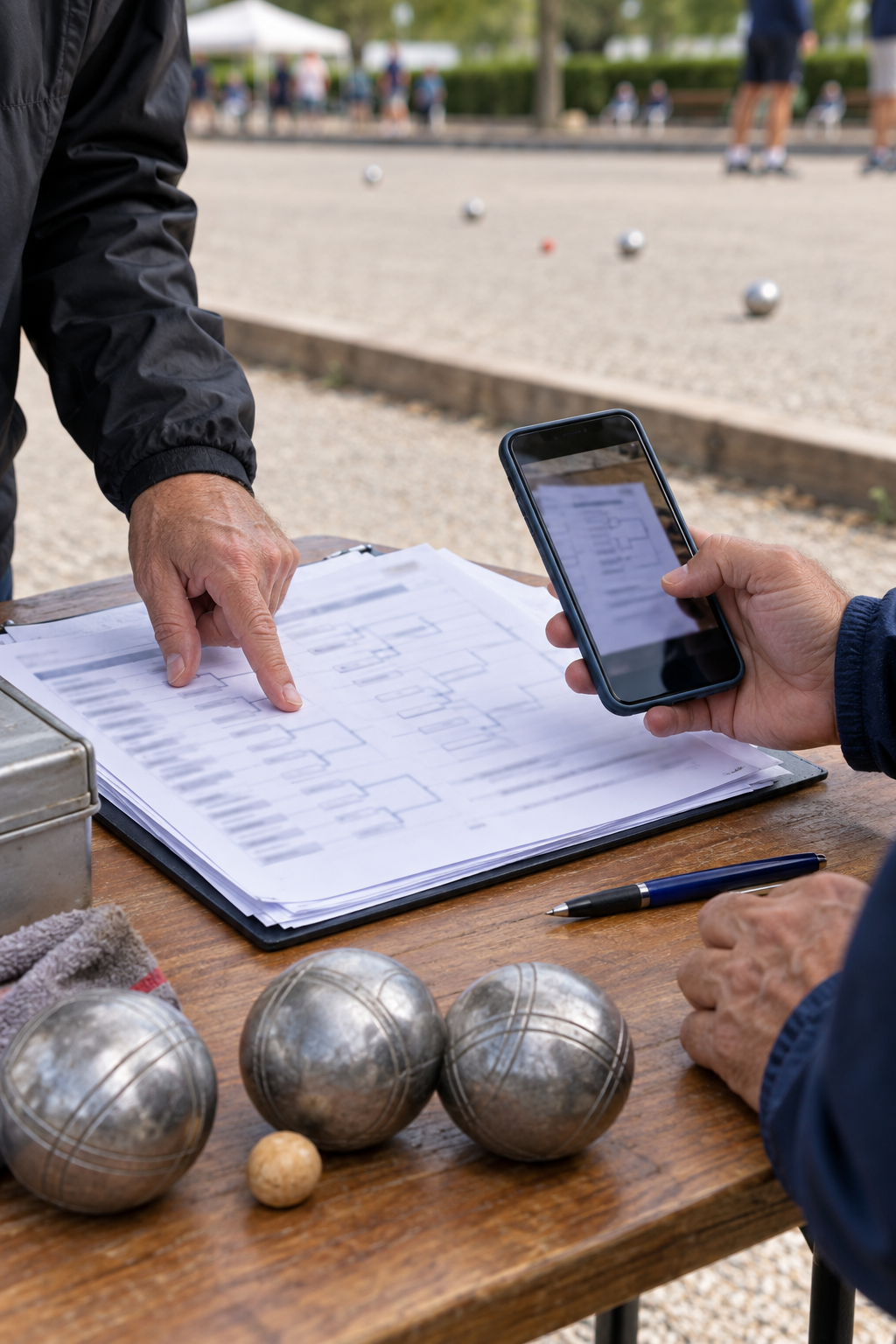
To organize a competition, allocate the courts and keep a clear schedule, a clean tool is better than a scribbled chart.
Discover the software