Actualités · 5 March 2026
Stainless Steel vs Carbon Steel Boules: Which to choose for your style of play?
Grip, cushioning, maintenance, hardness: a full comparison between stainless steel and carbon steel to choose the best pétanque boules for your style of play in 2026.Portrait of the two metals
Before deciding, you need to understand what happens at the molecular scale. The two steels are not just “shiny” or “dull” — their chemical compositions define radically different physical behavior on the ground.
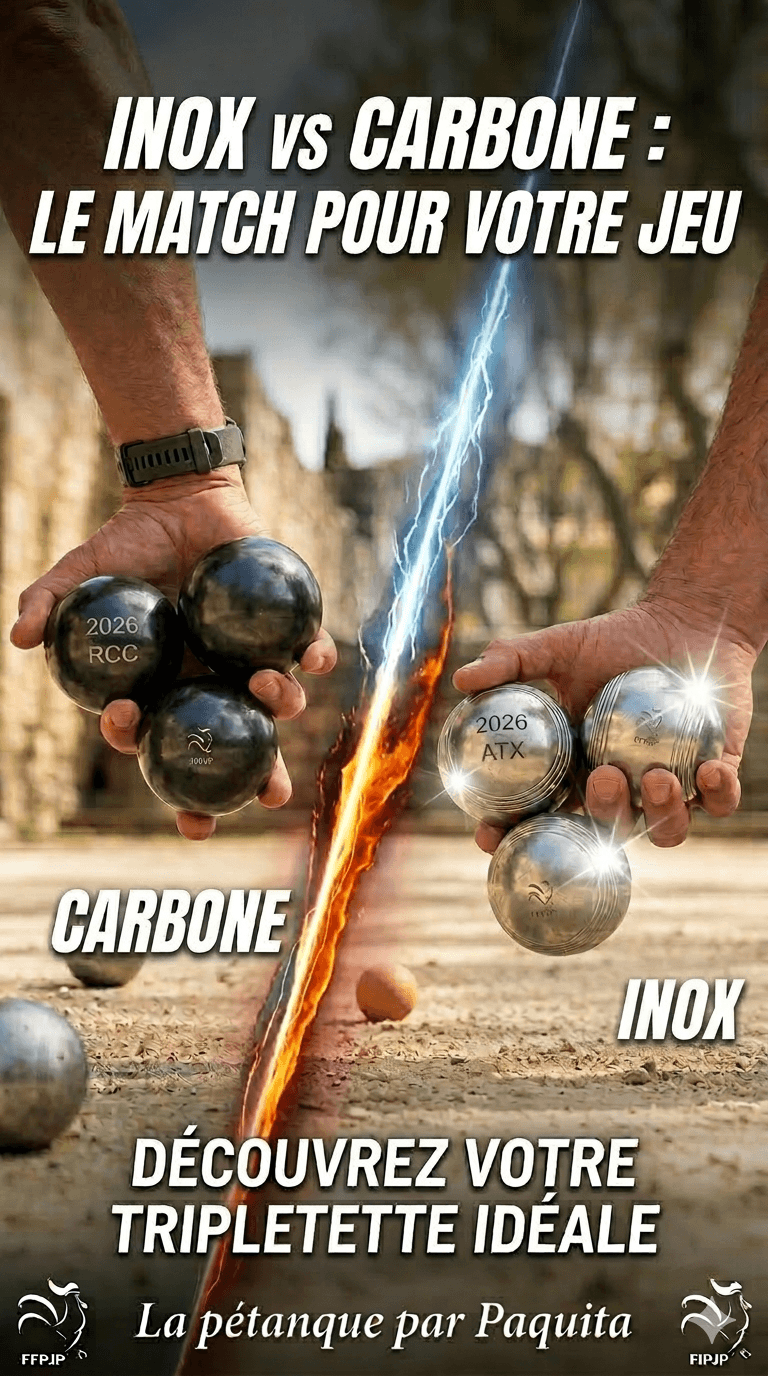
🔥 Carbon SteelThe metal of feel and grip
Shooter Strong grip Max shock absorption Maintenance required VS 💎 Stainless SteelThe metal of consistency and longevity
Pointer Soft touch Zero rust 10-year lifespanThis duel is at the heart of every serious triplette purchase. It directly extends the questions covered in our complete guide to choosing your boules in 2026 — where we also explain the importance of hardness and weight according to your profile.
Carbon steel: the “living” metal
Carbon steel is an alloy of iron and carbon (between 0.02% and 2.1% depending on the grade). For the pétanque player, it's the steel of pure feel. It reacts to the environment, adapts to your hand, and offers mechanical properties that stainless steel cannot reproduce.
🤜 The Phenomenal Grip- By oxidizing slightly, carbon creates a natural micro-roughness on the surface
- The boule never slips in the palm — it “sticks” to the hand, ideal for sweaty hands
- The release is more precise because the release point is always identical
- Decisive advantage on high-speed shots where grip is critical
- Available in a very soft (110 kg/mm²) version — the softest on the market
- They absorb the shockwave on contact with the ground or the opposing boule
- It is the metal of carreaux that stay in place — the boule does not bounce back
- Ideal on stony ground where the bounce is unpredictable
If you play with carbon, wipe with a cloth soaked in Vaseline oil or WD-40 after each game. Without this maintenance, your boules will end up as “rust balls” in less than a month, especially if you play in the rain or on wet ground!
The 2026 season, with its more natural and irregular grounds, is particularly favorable to carbon. Shock absorption on stony ground is clearly superior to stainless steel, especially for shooters looking for the carreau that stays in place.
Stainless steel: the unalterable nobility
Stainless steel contains at least 10.5% chromium, which forms a passive chromium oxide layer on the surface — invisible to the naked eye, but absolutely impervious to rust. It's a metal that requires no attention, but demands a smoother and more mastered release technique.
🪶 Soft and Consistent Touch- Softer, more satin contact — pointers love this feeling of controlled glide
- Releases the boule without any parasitic snag, ideal for delicate precision releases
- The consistency of the gesture is easier to reproduce thanks to the constant surface
- Less sensitive to temperature variations than a seasoned carbon
- You play in the rain? No problem. No trace of oxidation.
- Stored in a damp garage? They'll stay like new.
- More expensive to buy, a stainless steel triplette can last 5 to 10 years without losing its properties
- A long-term investment, profitable from the third season onward
If you're starting pétanque or frequently change clubs while traveling, stainless steel is your best ally. You put your boules in any bag, in any weather, and you find exactly the same boule 6 months later.
Visual comparison, criterion by criterion
To make the comparison concrete, here is how the two steels stack up on each important criterion:
🔥 Carbon 💎 Stainless Grip 92% 58% Ground shock absorption 90% 62% Consistency 70% 95% Longevity 55% 95% Ease of maintenance 40% 98% Wet ground 60% 88% Stony ground 88% 65% Value for money 75% 80%Full summary table
| Characteristic | 🔥 Carbon Steel | 💎 Stainless Steel | Advantage |
|---|---|---|---|
| Composition | Iron + carbon (0.02–2.1%) | Iron + chromium (min 10.5%) | — |
| Grip | Excellent (micro-roughness) | Smooth / slippery | Carbon |
| Ground bounce | Low — very dead | Medium — livelier | Carbon |
| Usual hardness | 110–130 kg/mm² | 115–140 kg/mm² | — |
| Rust resistance | Low — maintenance required | Excellent — passive chromium | Inox |
| Longevity | 2–4 seasons (with maintenance) | 5–10 years minimum | Inox |
| Maintenance | Oiling after each game | None — rinsing is enough | Inox |
| Ideal for... | Pure shooter, carreau that stays in place | Pointer & midfielder | Profile-dependent |
| Wet ground / rain | ⚠ Risk of accelerated rust | ✓ No problem | Inox |
| Stony ground 2026 | ✓ Superior absorption | More pronounced bounce | Carbon |
Maintenance: what nobody tells you
Maintenance is the point that most often causes regret over a carbon purchase. Here is the complete protocol to preserve your boules — and avoid the bad surprise at the end of the season.
Maintenance protocol for carbon boules
- After each game: immediate cleaning Wipe your boules with a dry cloth to remove any trace of moisture or dirt before storing them. This is the golden rule.
- Applying protective oil Apply a thin layer of Vaseline oil, WD-40 or light mineral oil with a soft cloth. Focus on the grooves — that's where moisture settles.
- Storage in a dry place Avoid damp car trunks or unheated garages in winter. A closed case inside the house is ideal.
- Monthly check during the season Visually inspect the boules once a month. A rust spot treated immediately is easy to remove — ignored, it eats into the metal and makes the boule non-approved.
A carbon boule with deep oxidation can lose weight beyond the 15 g tolerance and be refused in competition. Check your boules' weight regularly with our guide how to check FFPJP approval.
Maintaining stainless steel boules: ultra-simple
For stainless steel, a rinse with clean water after muddy games and a quick dry are enough. No chemical product is needed. This is one of the great assets of stainless steel for players who don't want to spend time on maintenance.
Which metal for which terrain in 2026?
The 2026 season marks a turning point with the return to natural and irregular grounds. This change has direct consequences on the choice of metal, more than ever.
🪨 Stony grounds / relief- The soft carbon dominates — superior absorption on irregular impacts
- Ideal for pointing on rough ground without uncontrolled bounce
- Shooters with hard carbon keep more energy on impact
- The stainless steel is essential — no risk of accelerated oxidation
- The glide consistency is not affected by ambient humidity
- No stress about storage after a game in the rain
- Stainless steel excels on dry and hard ground, predictable glide
- Carbon can become too grippy on very dry and dusty ground
- Climate conditions in the South: stainless steel recommended
- In competition with changing grounds, the medium carbon (120 kg) offers the best compromise
- Adaptable to both shooting and pointing depending on the end
- Preferred by versatile triplette players
Reminder: in 2026, the new rules forbid preparing the ground by sweeping before a shot. Your boule will therefore have to adapt to the ground as it is — all the more reason to choose your metal carefully according to the expected terrain.
PétanqueLand's verdict
Don't get it wrong: the choice of metal is a matter of feel, playing style and practical constraints. There is no wrong answer, only an answer suited to your profile.
🔥 Choose Carbon if…- You are a shooter and are looking for the carreau on the spot
- You have sweaty hands or often play in hot weather
- You play on grounds that are stony and irregular
- You like to “feel” the material in your hand
- You accept 2 min of maintenance after each game
- You store your boules in a dry place
- You are to point or a versatile player
- You often play in wet or rainy weather
- You want an investment lasting 5–10 years
- You prefer consistency and steadiness of gesture
- You don't want to think about maintenance
- You're a beginner and looking for a boule that forgives mistakes
FAQ — Your frequent questions
Can we mix carbon and stainless steel in a triplet? + Technically yes — no FFPJP text prohibits balls of different materials in a triplet, as long as each ball is approved individually. In practice, the sensations will be very inconsistent. Reserve this mixture for training to test, never in serious competition. Does carbon really rust that quickly? + Yes, especially in humid regions or after a game in the rain. Without maintenance, traces of rust appear in 2 to 4 weeks. With regular oiling after each game, carbon balls can last several seasons without problem. Maintenance is not an option, it is a condition. Are carbon balls really softer than stainless steel? + Not always. Hardness depends on the heat treatment of the ball, not just the material. There are very hard carbon balls (130 kg/mm²) and very soft stainless steel balls. But the "ultra-soft" versions (110 kg/mm²) are more often available in carbon than in stainless steel. Check out our guide to selection criteria to understand the hardness scale. Which metal for the 2026 French championships? + Both are FIPJP approved. The choice depends on the competition field. For the French championships, often contested on mixed terrain, shooters mainly opt for medium carbon (120–125 kg/mm²), while pointers favor polished stainless steel. Also check the official 2026 calendar to identify locations and anticipate the type of terrain. Does stainless steel also need to be maintained before the competition? + No in terms of rust protection. But before a competition, a gentle polishing with a microfiber cloth gives the stainless steel its optimal glide and cleans any dirt or limescale residue which can slightly change the feel. Also think about check the weight and approval before each season. Is carbon banned in certain competitions? + No, carbon balls are fully FFPJP and FIPJP approved in the same way as stainless steel. The only universal condition: the model must appear in the official approval list, whatever the material. Consult the procedure for approval verification procedure if you have any doubt. 📎 Related articles Equipment Guide Which bowls to choose to dominate the 2026 season? Test & Ranking Test: the 3 best balls for shooters in 2026 Approval How to check if your bowls are FFPJP / FIPJP approved? 2026 Regulations The return to “wild” pétanque — what it changes for your equipment 2026 Regulations Sweeping costs a card — Article 10 clarified Administrative New paperless FFPJP licence with QR code Competitions Official 2026 competition calendar Video Why changing boules doesn't change your level?© Pétanque by Paquita — petanqueland.fr
Informative guide based on the 2026 FFPJP/FIPJP regulations. Not affiliated with the brands mentioned.