Actualités · 6 May 2026
Team communication: talking too much or not enough? (Pétanque)
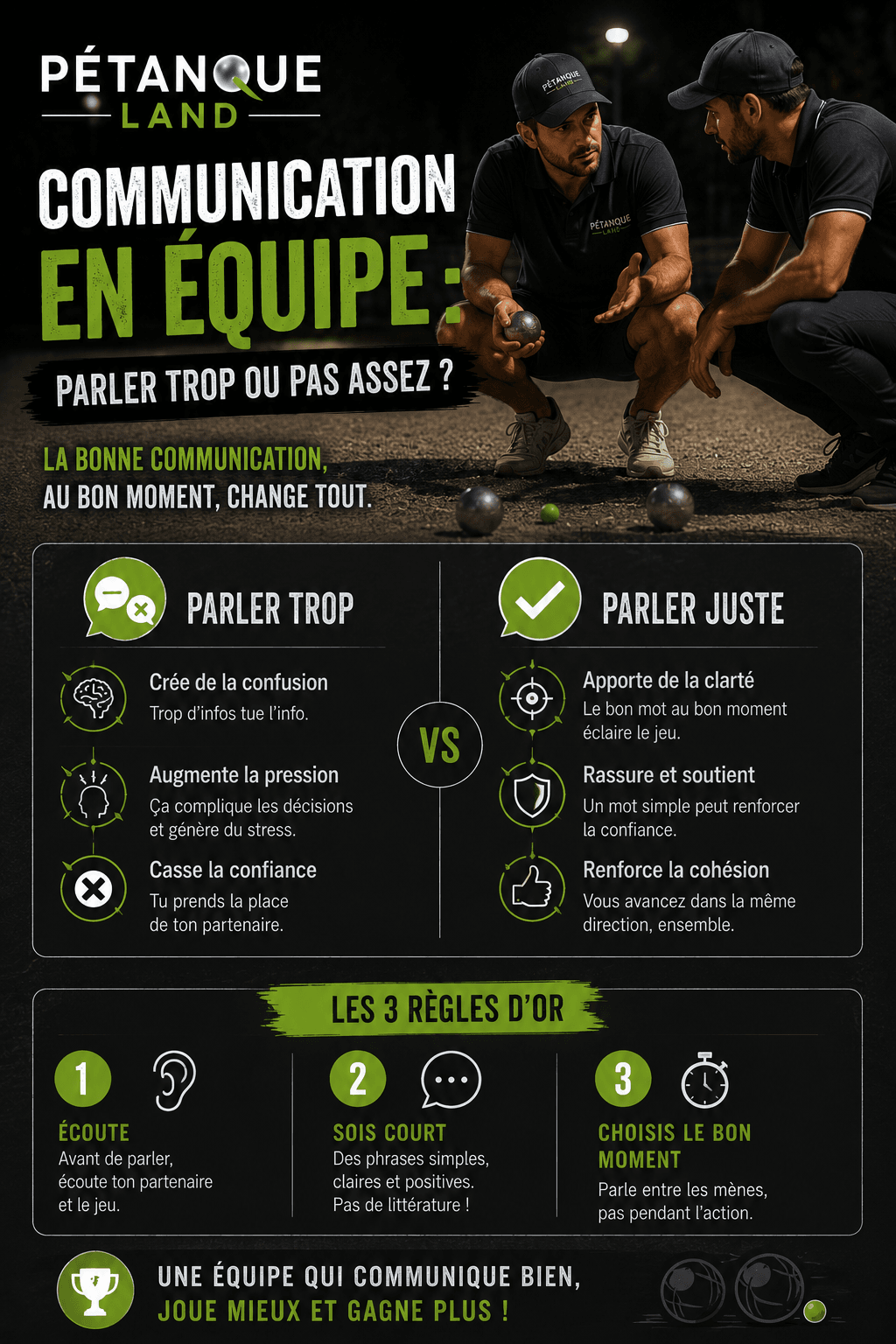
Talking too much is distracting. Not talking enough is isolating. In between, there's a communication that really helps theThe communication spectrum: from "too much" to "not enough"
Communication in play is not judged by volume — it is judged by usefulness. A single sentence at the right moment is worth more than ten diffuse comments. A silence decided together is different from a silence endured. The first problem to solve is not "how much do we talk?" but "does what we say help us play better?"
⚠️ TALKING TOO MUCH Commenting on every bowl, analysing mid-end, encouraging after every throw, giving unsolicited advice, filling every silence. The player receives more information than they can process and throws in an overloaded cognitive state. → The player's concentration captured by the conversation instead of the throw ✅ JUST-RIGHT COMMUNICATION Short exchanges, oriented toward the next action, formulated before the throw. Assumed silences between bowls. Feedback only when it is useful for the next — never to comment on the past bowl. → Every word said contributes to the decision or to morale — nothing more ⚠️ NOT TALKING ENOUGH Total silence, absence of positive or negative signal, players evolving in parallel without tactical coordination. The partner does not know whether they are supported, whether the strategy is shared, whether their play is heading in the right direction. → Isolation, tactical uncertainty, progressive loss of cohesion 🎙️ Paquita on communication during play "I've played with partners who talked to me all the time — distance, advice, encouragement, analysis — and I was so busy processing what they were saying that I could no longer concentrate on my bowl. I've also played with partners who never said anything — and after 4 ends I no longer knew whether we were playing together or each on our own. The best partner I had was the one who knew exactly when to speak and when to stay silent. It can be learned — but first you have to accept that it can be learned." — PaquitaThe 3 types of communication — what helps, what harms
Everything we say during a game belongs to one of these three categories. Identifying them makes it possible to know immediately whether what we are about to say has its place right now — or whether it's better to stay silent.
① Tactical communication — the information that helps decide Distance, position of the bowls, number of bowls remaining, shared decision on the shot to play. It is the only type of communication that is always welcome during an end — provided it precedes the throw and does not follow it. Tactical information given before the throw helps. The same information given after the throw is an analysis that adds mental load. → Useful examples: "their bowl is at 8 cm, we still have 2 bowls", "do you think we shoot or we point?", "jack at 7 metres, clean left side". Always before the throw, never after. ② Emotional communication — the support that maintains cohesion Encouragement, acknowledging a good bowl, neutralizing a mistake, maintaining the bond in difficult moments. This type of communication is useful — provided it is short, sincere and forward-looking. A sincere "good bowl" after a good point is worth a lot. A too-quick "it's nothing" after a mistake rings hollow. A long motivational speech between two bowls breaks concentration more than it restores it. → 5-word rule: any emotional communication during an end must fit in 5 words maximum. "Good bowl." "We have the point." "It's okay, next bowl." Beyond that, it's too long. ③ Social communication — what has no place during play Anecdotes, comments about the opponents, conversations with spectators, drawn-out jokes. Outside a game, all that is normal and healthy. During an end, it is a collective leak of concentration. The problem is not that it's "forbidden" — it's that it occupies limited mental bandwidth at the wrong moment. → Its natural place: between games, after the count of an end, during movement. Never during the running of an end where bowls are still to be played.When to speak, when to stay silent — timing is everything
The same word said at the right moment helps. Said at the wrong moment, it disrupts. The timing of communication is often more important than its content.
⏱️ TIMING GUIDE — THE COMMUNICATION WINDOWS When each type of communication has its place Before placing the jack — full tactical window INTER-END This is the best moment for any tactical discussion — strategy for the end, chosen distance, targeted zone, each one's roles. The player is not yet in throw preparation. They can process complex information without interference. During throw preparation — silence or 5 words maximum PRE-THROW As soon as the player takes their bowl and concentrates, the communication window almost entirely closes. A short, factual piece of information remains acceptable — "8 metres, right side". Any longer sentence breaks the concentration routine. In the 3 seconds after the throw — neutrality or nothing POST-THROW The bowl has just left — what's done is done. The 3 seconds following the throw are not a feedback moment. Neither excessive positive comment nor negative analysis. Active neutrality is the best posture: observe the result and mentally move on to the next bowl. After the bowl comes to rest — brief, forward-looking feedback RESULT Once the bowl is placed, a short feedback is possible and useful — "good bowl, we have the point" or "it's okay, their bowl is still at 15 cm". These short signals maintain cohesion without restarting a conversation. The rule: one sentence, oriented toward the current situation or the next bowl. After the count of the end — short analysis window END OF END The moment when analysis of the end just played is acceptable — provided it stays brief (30 seconds max) and ends on an objective for the next end. An analysis that drags on while walking toward the new jack consumes the tactical window of the next end. 🔑The timing of communication follows a simple rule: everything that helps the player play their next bowl better is welcome — everything that holds them in the past bowl is harmful. The question is not "is what I'm about to say true?" but "is it going to help or to weigh down?"
What we really say — useful phrases vs toxic phrases
Certain phrases come back systematically during a game. Some help. Others harm — even when they stem from good intentions. The difference is often subtle.
📋 FIELD DICTIONARY What we say, what it produces, what we should say instead After a partner's mistake "It's nothing, it's nothing, don't worry!" WEIGHS DOWN "You should have shot instead of pointing there." USELESS [Silence — neutral gaze toward the bowls] OPTIMAL "Their bowl is still at 20 cm, we have the shot." USEFUL Before an important throw "Come on, this one matters, don't miss it!" PRESSURE "You can do it, I trust you." WEIGHS DOWN "Jack at 7 metres, clean right side." USEFUL [Silence — let the player prepare] OPTIMAL After a good bowl from the partner "YEAH! So good! That's exactly it!" OVER THE TOP "Good bowl." USEFUL "We have the point, watch their next bowl." OPTIMAL For a shared tactical decision "Shoot! Shoot the bowl!" (an order, not a discussion) DIRECTIVE "What do you think — shoot or point?" USEFUL "I think we shoot, you see it better than I do from there." OPTIMALThe 4 communication profiles and their blind spots
Every player has a natural communication style. Identifying your own — and your partner's — makes it possible to anticipate frictions and calibrate the necessary adjustments.
🗣️ THE PERMANENT COMMENTATORThey comment on every bowl, give an analysis after every throw, encourage before and after. Their communication is sincere but uninterrupted. The partner never gets silence to concentrate.
Their blind spot:They confuse "being there for their partner" with "talking all the time". Silence feels like indifference to them when it is often the best gift they can give.
Calibration: set a strict rule — speak only before the throw or after the bowl has come to rest. Never during. 🤐 THE TOTAL MUTEThey say almost nothing during the game — neither before nor after. They play in their bubble, assuming the partner knows what they think. Their silence is often a form of concentration — but it deprives the team of tactical coordination.
Their blind spot:They assume the partner "sees the same thing" as they do. In reality, the total absence of signal creates uncertainty about strategy and can be perceived as disinterest or tension.
Calibration: impose two mandatory tactical exchanges per end — before the jack and before your own decisive bowl. 😤 THE EMOTIONAL REACTORThey communicate mostly when things go badly — visible frustration, negative comments after a mistake, cold silence after a bad end. Their communication is inversely proportional to the quality of their play.
Their blind spot:They do not realize that their emotional reactions constitute communication — and often the most harmful kind. The sigh, the gaze, the posture are all received by the partner.
Calibration: become aware that every visible behaviour is communication. Set a behaviour standard independent of the score. 📋 THE TACTICAL CHIEFThey run every end — announce the distances, decide the shots, give the instructions. Their communication is tactically sound but one-sided. The partner executes without thinking and progressively loses initiative.
Their blind spot:They turn the doublette into a hierarchy — which can work for a few ends but creates dependence and passivity in the partner in the medium term.
Calibration: replace directives with questions — "I think we shoot, how do you see it?" — to maintain shared thinking.Table: situation → good communication → mistake to avoid
| Situation | Useful communication | Timing | Common mistake |
|---|---|---|---|
| Start of end — jack to place | Tactical discussion: distance, zone, strategy | Before the jack | Saying nothing, each assumes the same thing |
| Partner about to throw | Silence or 1 short piece of info: "8 metres, straight ahead" | Pre-throw | Long encouragement that breaks the preparation |
| Partner just missed | Neutrality — silence or info on the current situation | Post-mistake | Excessive "it's nothing!" or analysis of the mistake |
| Shoot vs point decision | "What do you think — shoot or point?" | Before the throw | "Shoot!" with no discussion — unilateral directive |
| Big end lost | Short reset — silence, then objective for the next end | Inter-end | Prolonged analysis of the end while moving |
| Partner's good bowl | "Good bowl" + info on the situation | Post-throw | Excessive celebration that over-relaxes and lets go |
| Tension between partners | Functional silence + purely tactical communication | During the game | Trying to resolve the tension during play |
| End of a lost game | Immediate silence then a clear-headed review | Post-game | Hot-headed review with reproaches or justifications |
Before speaking during a game, one inner question: "Does what I'm about to say help my partner play their next bowl better?" If the answer is no — even if what you want to say is true, fair, or well-intentioned — keep it for later. The game is the wrong place for truths that do not serve the next throw.
Exercises to calibrate team communication
01 The game with explicit communication rules 📍 Training in pairs ⏱️ 1 complete game 🎯 Test a defined communication standardDefine the exact communication rules before the game — and follow them throughout the game to measure their effect.
Before starting, define 3 simple rules together. Example: (1) tactical discussion only before the jack, (2) 5 words maximum during the throw, (3) no comment on a past bowl during the end. These rules must be formulated by both players together, not imposed by one. Play the complete game applying these rules strictly. If a rule is broken, the player who broke it notes it mentally — without interrupting play to flag it. The game does not stop for communication about communication. After the game, compare the observed violations: at which moments were the rules hardest to keep? These moments reveal the situations where the usual communication is least controlled — and therefore the most important to work on. Variant: play one game with voluntary maximum communication (saying everything, commenting on everything) then one game with near-total silence. Compare the quality of play in both cases. Most duos find that controlled silence produces better play than intense communication — and that just-right communication produces the best of both. 02 The calibration conversation — off the terrain 📍 Outside a game — café, boulodrome ⏱️ 15 min 🎯 Align communication expectations before the problemMost communication frictions during a game come from implicit expectations never voiced. This exercise makes them explicit — before they create a problem.
Each player answers 3 questions individually: (1) What do I appreciate my partner saying to me during a game? (2) What distracts or annoys me in our current communication? (3) What would I like us to change? The answers are honest, without trying to spare the other. Share the answers in turn, without interruption. The other listens without defending or explaining — just receiving the information. This format prevents the conversation from becoming a debate or mutual reproach. Build together 2 or 3 concrete rules drawn from these observations. These rules must be formulated in the positive — "we give a tactical piece of info before every decisive shot" rather than "stop commenting on my mistakes". What to do, not what not to do. Test these rules over 3 games, then do a short review: were the rules kept? Did they improve the mood and the play? What still needs adjusting? This short test-and-review cycle is the most effective for building a durable communication style.FAQ — Your frequent questions
My partner takes any comments badly during the game. How can I pass on useful information to him without upsetting him?+ If every comment is received as criticism, the problem is not the comment — it's the context in which it is given. During the game, after an error, the player is in a state of vulnerability: the same information that would be neutral in other circumstances is filtered by frustration. The solution: pass all tactical information before the throw, not after the error. “Their ball is 12 cm away, we need a good pointer” before throwing doesn’t offend anyone. “You should have dosed better” after the error is inevitably received as a reproach, even when said calmly. In triplets, how can you avoid all 3 players talking at the same time and creating confusion?+ Triplet requires a more structured communication protocol than doublet — 3 simultaneous opinions before an important throw creates exactly the opposite effect of what we seek. The simplest solution: designate a “main communicator” per round or for each move — the one whose role is to provide tactical information. The other two observe and intervene only if the information is absent or erroneous. In practice, it is often the player best placed to see the balls who takes this role naturally — but naming it explicitly avoids overlap. Is it normal to not speak at all during certain sessions when "you're in the flow"?+ Not only is this normal — it's often a sign that the team is playing in the best possible condition. Duos who know each other well develop an implicit common reading: each knows what the other sees, decisions are made by look or gesture rather than by words. This “silence of flow” is fundamentally different from the silence of tension or insulation. The difference is felt immediately — in a silence of flow, both players are connected and focused. In a tense silence, everyone is in their bubble of frustration or worry. The first is to cultivate. The second is a warning signal. How to communicate with an opponent or a partner you don't know — like in an impromptu competition?+ With an unknown partner, the first instinct is to adapt your communication to the other's style — observe their reactions to initial communications and adjust quickly. If the partner responds well to short tactical exchanges, continue them. If he seems distracted by the information, reduce it to the bare minimum. In the absence of information on one's preferences, a simple and respectful rule: tactical communication only, formulated as a question and not as a directive, limited to key moments. This approach is rarely poorly received and creates the conditions for communication which can be refined as the game progresses. 📎 Related articles DuoWhen your partner makes you lose: reacting intelligently TacticThe key moments where a game really turns TacticsAttack or secure: making the right choice at the right time TacticsPlaying against a stronger opponent: the mistakes to avoid TournamentsOfficial 2026 calendar — outdoor tournaments ToolsFree PetanqueLand tools© Pétanque by Paquita — petanqueland.fr · 📖 Paquita's book on Amazon