Actualités · 6 February 2026
Which boules to choose to dominate the 2026 season?
Hardness, weight, material, FFPJP approval: everythingAdapting to the new 2026 terrains
As we detailed in our feature on 2026 rules and the return to wild pétanque, "billiard" terrains — those smooth, regular and predictable surfaces — are gradually disappearing from official competitions. The trend is towards selective, irregular surfaces, with relief and stones.
This evolution is not insignificant for your equipment. A set of boules perfectly suited to a smooth terrain can become uncontrollable on a granular surface. The 2026 season therefore requires choosing your boules based on the expected terrain, not just your playing habits.
At the same time, the new strict rules on sweeping the terrain and ground markings mean that you can no longer "prepare" your shooting area: the raw terrain is now the norm. You might as well be equipped accordingly.
📅Preparing for the season? Check out the official 2026 competitions calendar to anticipate the types of terrains by region and level.
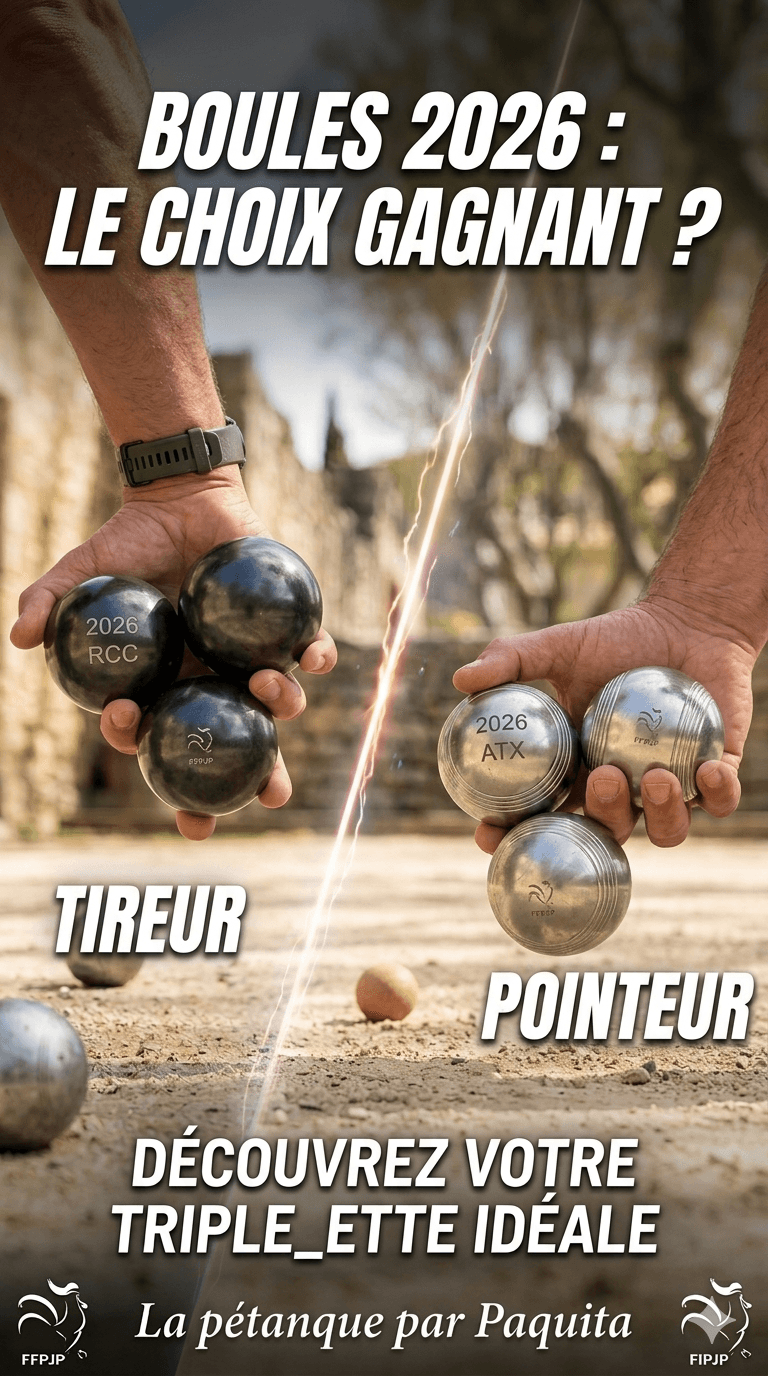
Shooter or pointer: two philosophies, two boules
Before any technical criterion, the question of your role in the team is decisive. The constraints of a shooter and a pointer are radically different:
💥 The Shooter- Favours a boule hard (7 to 9) to maximise the impact energy
- Preference for stainless steel on dry terrain, carbon steel on wet terrain
- Slightly smaller diameter to make the "closed fist" grip easier
- Wide grooves for better grip on release
- Recommended weight: 710 to 730 g depending on build
- Favours a boule soft (0 to 3) to absorb the bounce
- The polished stainless steel remains the benchmark for controlling slide on hard terrains
- Wider diameter for better stability on "open hand" release
- Fine grooves for softer ground contact
- Recommended weight: 680 to 710 g depending on preferred distance
To go further on this distinction, our full comparison Stainless steel vs carbon steel details the advantages of each material according to your style. And if you are a shooter, you can also find our test of the 3 best boules for shooters in 2026.
The 5 essential criteria for choosing well
Beyond the shooter/pointer profile, five technical parameters should guide your choice:
⚖️ WeightBetween 650 g and 800 g. Must match your hand size to avoid injuries over time.
📏 DiameterFrom 70.5 mm to 80 mm. A diameter suited to your grip improves accuracy and reduces fatigue.
🪨 HardnessFrom 0 (very soft) to 9 (very hard). An often underestimated criterion, it determines the boule's behaviour on the ground.
🔩 MaterialPolished stainless, satin stainless, carbon steel or treated steel. Each alloy has its area of excellence depending on the terrain.
〽️ GroovesThe type of grooving influences the grip and the effect of the boule. Test it in-store before buying.
Understanding boule hardness
Hardness is one of the least understood criteria among beginner players, yet one of the most decisive. It is rated on a scale of 0 to 9 according to manufacturers, from the most flexible to the stiffest.
🔢 Hardness scale — from 0 (soft) to 9 (hard) 0–1 2–3 4–5 6–7 8–9 0–1: Very soft — maximum absorption, pointer on hard terrain 2–3: Soft — pointer on varied terrains, ideal for beginners 4–5: Medium — all-round, mid-terrain 6–7: Hard — experienced shooter, frequent impacts 8–9: Very hard — expert shooter, high-intensity competitionOn 2026 "wild pétanque" terrains — irregular surfaces with lots of stones — pointers should drop one or two notches in hardness compared to their habit on smooth terrain. The aim is for the boule to "bite" the ground more instead of skidding off.
Conversely, shooters on stony terrains benefit from using a boule slightly harder so that the impact energy is transferred directly to the opposing boule without dissipating into the ground.
What weight for which hand?
The regulatory weight of boules is defined by the FFPJP rules between 650 g and 800 g. In practice, most players range between 680 g and 730 g. Here are the usual benchmarks by hand size:
660g Very small hand Rare, often young players 680g Small hand Women, slim seniors 700g Average hand Most common weight 710g Standard hand The competition benchmark 720g Large hand Experienced shooters 730g Very large hand Powerful shootersGolden rule: if you have to strain to hold the boule, it is too heavy. If you feel it "floating" in your hand, it is too light. The right weight is recognisable by the natural relaxation of the gesture. Useful video on the subject: Why changing boules doesn't change your level.
Comparison of the major brands 2026
The 2026 market sees the arrival of new innovative alloys, notably from MS Pétanque and Boulenciel, who are launching ranges that limit vibrations from repeated impacts. Here is a comparative overview of the major boule families available this season:
| Brand / Range | Material | Hardness | Profile | 2026 strong point |
|---|---|---|---|---|
| Obut Stainless | Polished stainless | 3–7 | Mixed | FFPJP benchmark, very wide range of hardnesses |
| Obut Carbon | Carbon steel | 6–9 | Shooter | Excellent on wet terrains, clean impact |
| MS Pétanque Pro | Anti-vibration stainless | 4–8 | Shooter | New: reduces joint micro-trauma |
| Boulenciel Terre | Treated soft alloy | 0–3 | Pointing | Exceptional absorption on stony ground |
| La Franc-Comtoise | Satin stainless | 3–6 | Mixed | Excellent value for money, ideal for clubs |
| JB Pétanque | Polished stainless | 2–7 | Pointing | Very careful finish, appreciated on sandy terrains |
For an in-depth technical comparison between the two major material families, read our article: Stainless vs Carbon steel boules — which to choose for your playing style?
Approval and inspection — what can disqualify you
With the switch to the FFPJP digital licence, boule inspections have been considerably simplified for referees. The checking devices are more precise and faster. In other words: it is now easier to be refused a non-compliant boule.
⚠ FFPJP rule — Weight loss limitA boule is banned in official competition if it has lost more than 15 g compared to the weight engraved on the boule. Systematically weigh your triplet at the start of the season.
Checklist before heading to a competition
- ✓Readable logo and engraving: the model number and weight must be identifiable to the naked eye. An overly worn boule may be refused.
- ✓Weight within limits: weigh your boules and check that the loss does not exceed 15 g. A precision scale is essential.
- ✓Compliant diameter: between 70.5 mm and 80 mm. A split or deformed boule is immediately disqualifiable.
- ✓Approved model: check that your set is indeed on the up-to-date FFPJP/FIPJP approval list.
- ✗Non-regulatory personalised markings: certain engravings or stickers may lead to a refusal. Check with your referee.
- ✗Non-approved surface treatments: any modification of the surface (coating, unofficial anti-scratch treatment) is prohibited.
To learn all about the checking procedure, consult our dedicated guide: How to check whether your boules are FFPJP / FIPJP approved?
Our advice before buying
Investing in a good triplet in 2026 means ensuring a successful transition to the new imposed style of play. A few principles to keep in mind:
🖐Try before you buy. Weight and diameter are felt in the hand — a test of a few throws is worth more than all the technical specs. Many clubs allow you to borrow boules during training sessions.
💶Budget for the whole thing. A competition triplet costs between €80 and €250 depending on the brand. Use our free tools to plan your season and anticipate your expenses.
🧪Avoid impulse purchases. As our popular video shows, changing bowls doesn't change your level. The consistency of your technique weighs more than the brand of your triplet.
📋Think about your clothing too. The 2026 season bans jeans in official competition. Consult our guide on mandatory sportswear in 2026 and the psychological impact of clothing on your game.
FAQ — Your frequent questions
Can we use the same balls for pointing and shooting? + Technically yes — nothing prevents you from playing both roles with a “mid-range” ball. In practice, multipurpose balls (hardness 4–5) are less effective than balls specialized in each discipline. If you play both roles depending on the game, choose a compromise around hardness 4. Are all balls sold in stores FFPJP approved? + No. Certain “leisure” balls sold in supermarkets or on the internet do not appear on the official approval list. Before any purchase for competition, check that the model is correctly referenced. Our guide how to check approval explains the process step by step. Is carbon really better than stainless steel for shooters? + Not universally. Carbon offers a “dryer” shock and better consistency on wet or cold terrain. Polished stainless steel remains superior on dry and hot grounds for its regularity. Check out our Stainless vs Carbon steel comparison to choose according to your region and your season. How long does a competitive game of boules last? + With regular use in competition (several competitions per month), a quality triplet lasts 3 to 5 seasons before weight loss or wear of the grooves becomes a problem. “Leisure” balls wear out more quickly. Check weight at least once per season. What is the price of a good competition triplet in 2026? + Count between €80 and €150 for an entry-level competition triplet (Obut Match, JB base, La Franc-Comtoise). The high-end ranges (Obut Prestige, MS Pro, Boulenciel Expert) sit between €160 and €250. Beyond that, you are in the field of tailor-made products. Can we play with balls of different brands in the same triplet? + Yes, no FFPJP rule requires that a player's three balls be of the same brand, provided that each ball is individually approved. On the other hand, for the consistency of your game, it is strongly recommended to have identical balls or at least of the same hardness. 📎 Related articles Test & Comparison Test: the 3 best balls for shooters in 2026 Test & Comparison Stainless steel vs carbon balls: which one to choose according to your playing style? Approval How to check if your bowls are FFPJP / FIPJP approved? 2026 Rules The return to "wild" pétanque — what it really changes 2026 Regulations Sweeping costs a card — Article 10 clarified Administrative New paperless FFPJP licence with QR code Equipment Goodbye jeans: the FFPJP clothing revolution is here Video Why changing boules doesn't change your level? Tools All our free tools to plan your 2026 season© Pétanque by Paquita — petanqueland.fr
Informative guide based on the 2026 FFPJP/FIPJP regulations. Not affiliated with the brands mentioned.