Actualités · 20 July 2026
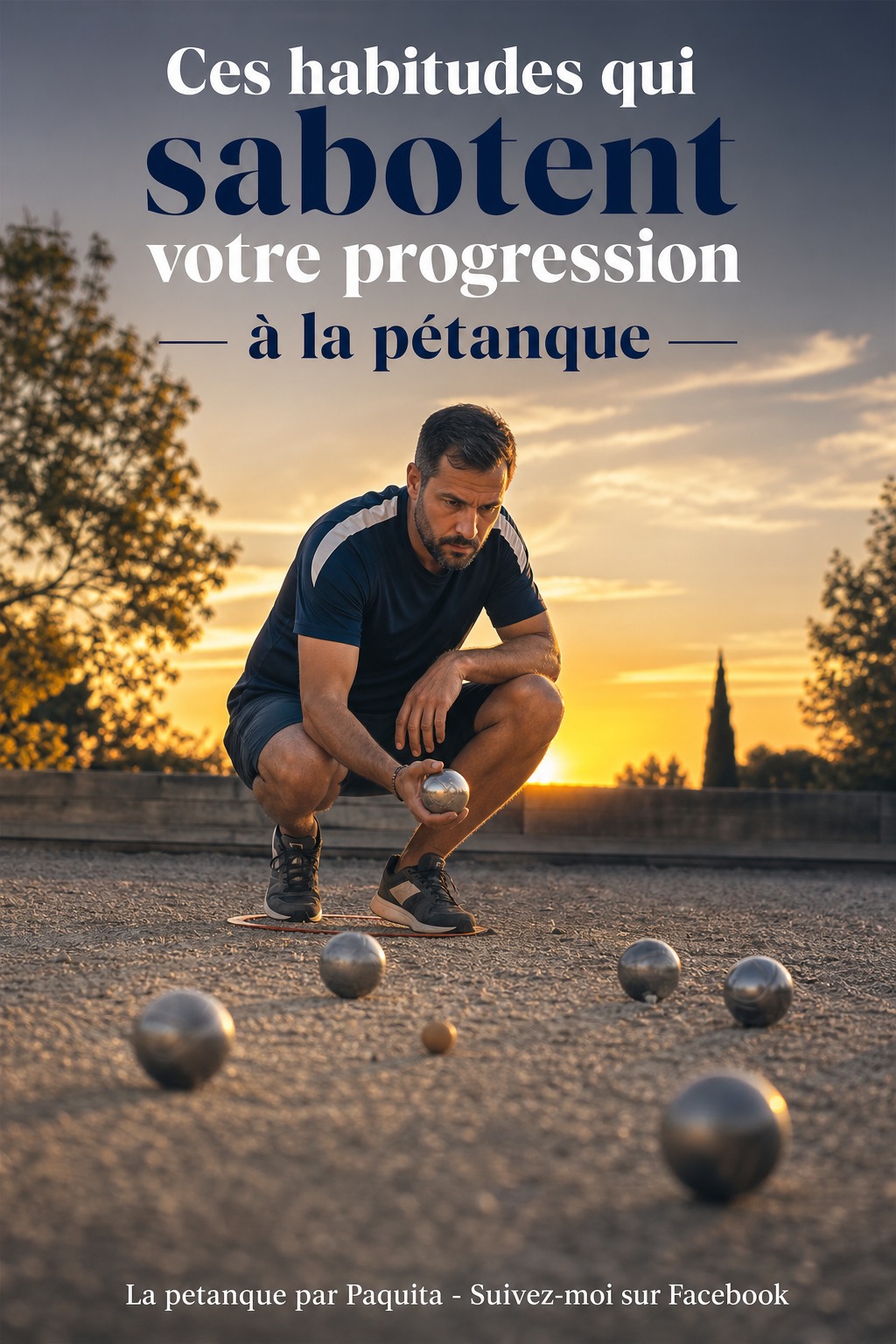
These habits that sabotage your progress in petanque
These habits that sabotage your progress in petanque: concrete markers, common mistakes and Paquita's tips to improve in petanque.1.Why you plateau without realizing it
Stagnation is rarely sudden. It sets in gently. You keep playing, you sometimes play beautiful boules, you keep a few reassuring markers. Yet the same mistakes come back and the margin for progress disappears. The problem is not the volume of play, but the lack of turning play into learning.
Many players think they're improving because they rack up games. In reality, they're mostly racking up habits, good or bad. If nothing filters, corrects and structures those repetitions, the level barely moves.
2.Playing a lot is not enough
Playing games is essential, but it doesn't replace directed training. In competition or in a mêlée, you play to win the end. In training, you should sometimes play to understand a weakness, test a weight or check a routine. Without this distinction, everything gets mixed up.
The trap is simple: the player leaves satisfied because he played for four hours, while he worked on no specific problem. This pleasant fatigue gives the illusion of a job well done.
3.The flight of the real weak points
Most players prefer to repeat what they already do fairly well. The pointer keeps pointing medium-long because it reassures him; the shooter avoids the shots that trouble him; the nervous player never willingly puts himself in a pressure situation. This comfort slows everything down.
Improving, on the contrary, demands a small dose of confrontation. You need to identify what lowers your real level and work on it without dodging. As long as you sidestep this point, your progress stays superficial.
4.The lack of concrete feedback
Without feedback, you misread your sensations. You think you "played well" because a shot went through, or "played badly" because a point stopped short, without looking at the quality of the choice, the action or the trajectory. The brain then retains imprecise messages.
Good feedback doesn't need to be complicated. It can fit in three notes: stated goal, result, probable cause. This simplicity is already enough to create real markers for progress.
5.The markers of a productive session
A productive session leaves clear traces: one area worked on, one instruction followed, one error better understood, one decision better mastered. It is measured not only by the number of successful boules, but by the quality of the information you bring back.
Players who progress quickly almost always end up with a clearer idea of their game. The others just end up with impressions.
6.How to break these habits
Start by choosing one theme per session: a distance, a type of terrain, an end's finish, a mental routine. Then deliberately limit the number of goals. Two axes are largely enough. Below that, the session is empty; above it, it scatters.
Finally, always end with a short written review. What has improved? What is still blocking? What will you do again next time? This simple ritual turns the habit of playing into a habit of learning.
Progress does not depend only on what you do, but on what you repeat without seeing it.
| Habit | Consequence | Useful replacement |
|---|---|---|
| Playing without a theme | No lasting reference point | Choosing a precise line |
| Avoid the weak point | Masked stagnation | Work on it first |
| Judging yourself on the spot | Imprecise analysis | Note the goal and the cause |
| Too many objectives at once | Scattering | Limit to two instructions |
Before each session, write a single sentence: “Today I want to better understand…” This simple framing profoundly changes the quality of the work.
Exercises, work plans and concrete markers to turn ordinary sessions into real lasting progress.
View resource7.Frequently asked questions
A little, but much more slowly than with structured sessions and precise feedback.
Because they are neither isolated, nor measured, nor reworked in a stable framework.
Both, but the priority weak point often deserves to open the session.
Yes, because it turns vague impressions into usable markers next time.
One or two focus areas are enough to stay demanding without scattering.