Règlement FFPJP · 15 July 2026
Can you play with non-approved boules in a pétanque competition?
Non-approved boules in a pétanque competition: what is allowed, what is not, how to check your equipment, and avoid a penalty.1.In a tournament, a leisure bowl has no place
Leisure pétanque accepts almost anything: beach bowls, family bowls, old sets with no legible marking. An official tournament, on the other hand, rests on a simple idea: all players must use comparable, identifiable and compliant equipment. A non-approved bowl can give an advantage, pose a safety problem, or make checking impossible in case of a dispute. The question is therefore not whether it rolls well, but whether it meets the criteria set for competition.
2.How to recognize an approvable bowl
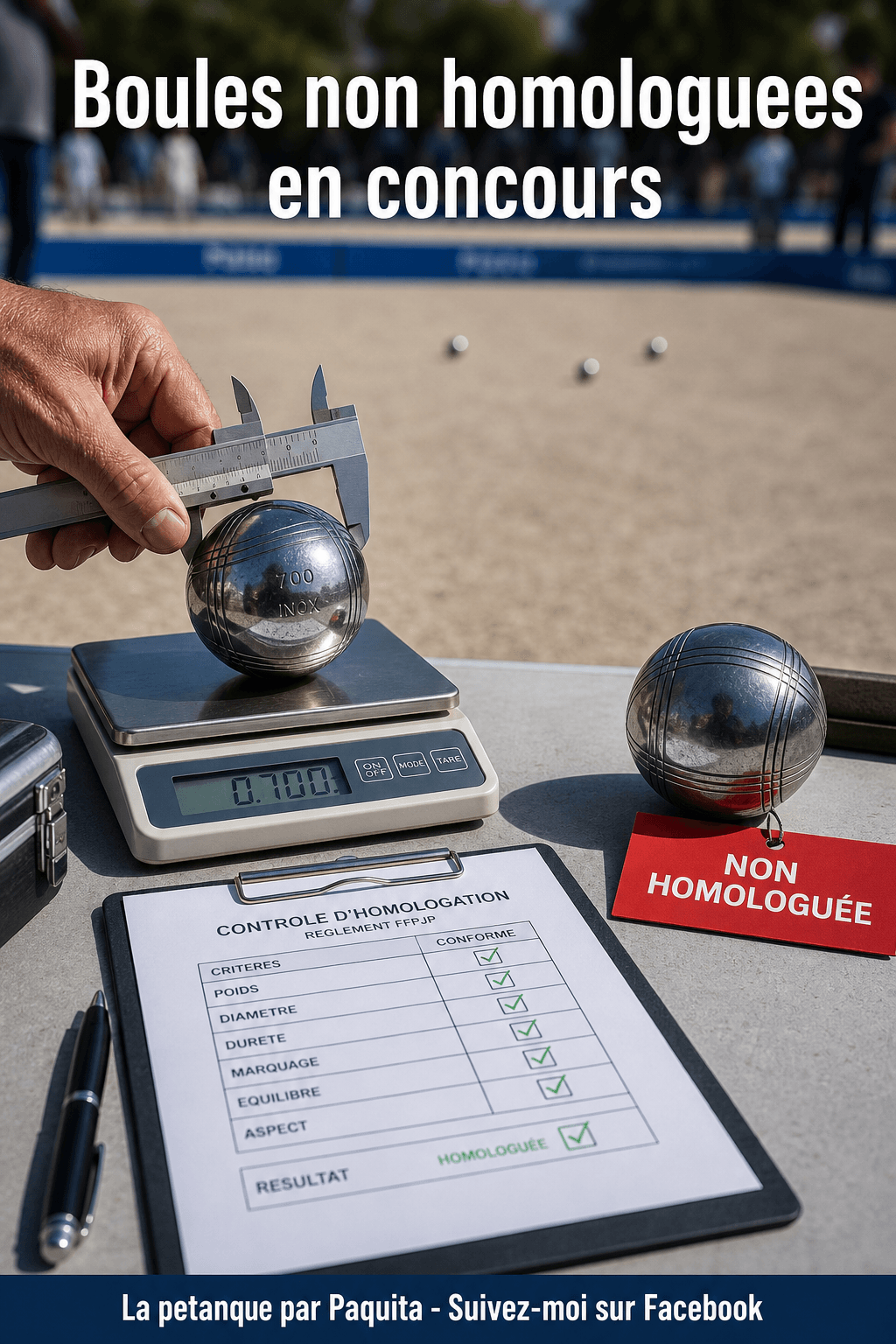
A competition bowl normally carries markings: manufacturer's mark, weight, sometimes model or serial number. This information identifies it and verifies that it corresponds to an approved manufacture. Leisure bowls, often lighter or filled differently, don't always offer these guarantees. If the marking is faded, incomplete or doubtful, the risk increases. A careful player checks their bowls before the tournament, not at the scoring table under the umpire's gaze.
Key point: don't touch anything until the situation has been recorded. In a tournament, the first practical mistake often consists of moving a bowl, a jack or a circle before clarifying the applicable rule.
3.What can an umpire check?
The umpire may look at the diameter, the weight, the general condition, the marking or a visible alteration. A bowl that is pierced, deformed, tampered with or impossible to identify can be a problem. The check isn't there to trap players, but to prevent non-compliant equipment from skewing the game. In practice, many disputes arise from an opponent's challenge: a bowl looks too small, too light or obviously modified. Better to arrive with a clean, legible and consistent set.
4.What does a player risk with non-compliant equipment?
Depending on the situation and the event's rules, the umpire can forbid the use of the equipment, require its replacement or apply a penalty if fraud or an infringement is found. The most troublesome part is often sporting: having to change bowls mid-tournament disrupts your hand, lob and shooting bearings. Even without a spectacular penalty, the player loses confidence. That's why a simple check before departure is worth more than a tense discussion during an important game.
| Situation | Good reflex | Common mistake |
|---|---|---|
| Doubt over a line | Record before touching | Replace by eye |
| Disputed equipment | Check the markings | Say "we've always played with these" |
| Decision dispute | Call the umpire | Negotiate under tension |
5.The cases that create the most confusion
Very old bowls, bowls given with a leisure set, bowls whose marking has disappeared and bowls that are visibly retouched are the most sensitive situations. Some players think a steel bowl is automatically valid. That's wrong. Others believe a bowl accepted in a friendly will be accepted everywhere. Also wrong. In a tournament, compliance isn't deduced from habit: it's verified against the official criteria and the actual condition of the equipment.
Before an official game, run a simple check: terrain, circle, jack, bowls, score and order of play. This routine takes less than a minute and avoids most pointless discussions.
6.The checking routine before a tournament
The day before a tournament, take five minutes: clean the bowls, check that the inscriptions are still legible, weigh them if you have a doubt, check for any deformation and prepare a compliant jack. Note also that the best bowl isn't only regulation; it must fit your hand and your position. A pointer, a shooter and a middle don't always look for the same diameter or the same hardness. Compliance is the minimum, not the end of the technical choice.
The more official the setting, the more visible small oversights become. The goal isn't to play with fear, but to play with method.
A compliant bowl isn't enough: you also have to know how to use it. This guide helps shooters work on trajectory, rhythm and precision with suitable equipment.
Discover