Actualités · 6 May 2026
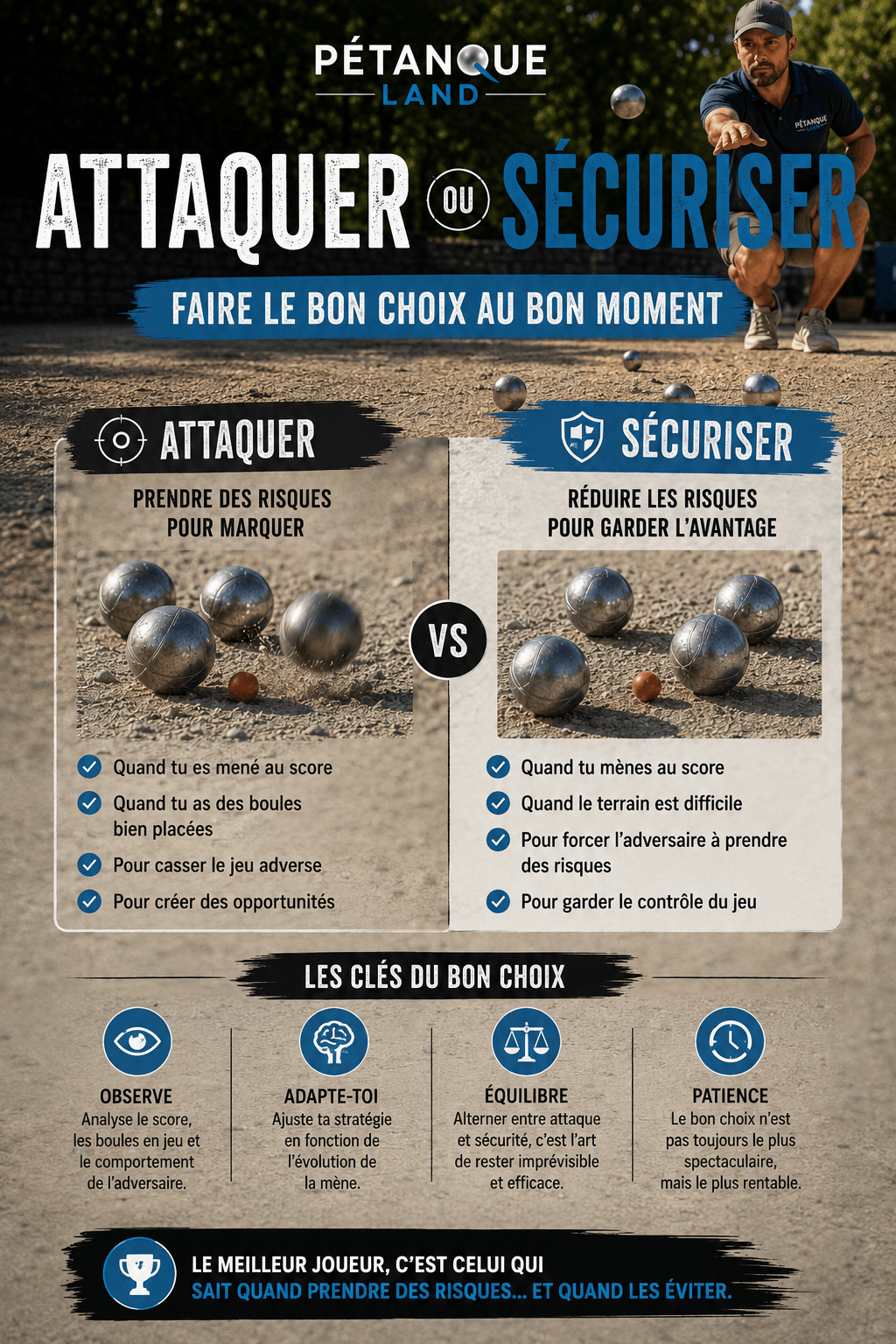
Attacking or holding in pétanque: making the right choice at the right time
Shoot or point? Attack or manage? ItThe fundamental mistake — deciding on instinct rather than on criteria
There are two ways to decide whether to attack or secure. The first, the most common: deciding based on what you feel — the frustration of a missed point, the urge to "do something", the fear of letting the opposing point stand. The second: deciding based on readable and reproducible criteria. The first method produces inconsistent decisions. The second produces improvable decisions.
🎙️ Paquita on tactical decisions "The player who shoots at everything that moves thinks they're aggressive. The player who points everything thinks they're cautious. In reality, both have simply decided once and for all and apply their decision regardless of the situation. A truly formidable shooter isn't someone who shoots at everything — it's someone who knows exactly when to shoot and when not to. The difference between a brilliant shot and a stupid shot is often just the context in which it was played." — Paquita 🔑Attacking or securing isn't a question of character — it's a question of probability calculation applied to the context of the end. A naturally aggressive player who learns to secure at the right time progresses faster than a naturally cautious player who never questions their choices.
The 5 criteria of a good decision
These 5 criteria must be evaluated together, not in isolation. None of them alone is enough to make a good decision — it's their combination that produces the right choice.
① My success rate on this specific shot — honesty required Not the ideal success rate, or the one from training on perfect terrain — the real success rate on this type of shot, on this terrain, in these conditions, under this pressure. If this rate is below 50%, attempting this shot statistically worsens the situation. The question is not "do I know how to play this shot?" — it is "do I make this shot more than half the time in this situation?" → A shooter who hits 7 shots out of 10 in training will often hit 4 or 5 out of 10 under the pressure of competition. It is this second figure that matters when making the decision. ② The cost of failure — what happens if I miss? Every missed shot has consequences — but they are not the same in every situation. A missed shot that leaves 3 opposing boules close to the jack does not carry the same cost as a missed shot that sends an opponent's boule far away. Systematically evaluate the failure scenario before deciding — if failure makes the situation significantly worse, the threshold for attempting the shot must be higher. → Shooting at an opponent's boule 5 cm from the jack with 2 opposing boules guarding it from behind: if the shot fails, all 3 boules remain in place. Assessing the cost of failure matters just as much as the probability of success. ③ The boules remaining in the end — the available resource A decision made with 3 boules still to play is not the same as one made with the last boule. With boules in reserve, a missed shot can be corrected. With the last boule, every error is final. The threshold for accepting risk must decrease as the boules are played during the end. → A risky attempt is acceptable with 2 boules remaining: if it fails, you can still play safe with the next boule. The same attempt with the last boule: the cost of failure is at its highest — so the threshold for attempting it must be too. ④ The score when the decision is made — the overall context of the match Leading 10-4 does not call for the same choices as leading 6-5 or trailing 3-10. The score changes the risk/reward ratio of every shot: when leading comfortably, securing is worth more than attacking — a point preserved is equivalent to a point won. When you are well behind, securing one more point changes nothing — only attacking can turn the match around. → At 12-6 up, attempting a difficult shot that could cost 3 points if it fails is irrational — you are risking 3 points to gain 0 additional points. At 3-10 down, the same shot is justified: maintaining the status quo already leads to defeat. ⑤ The opponents' position — what makes attacking necessary or pointless Sometimes, the opponents' position dictates an attack regardless of the other criteria: 3 opposing boules grouped close to the jack cannot all be countered by pointing — only a good shot solves the problem. Conversely, an opposing boule 30 cm away does not require a shot — a good point is often enough to take the point. Read the opposing situation objectively, without projecting your desire to attack or secure. → If the opponent has a boule at 5 cm and two boules at 15 cm: pointing to get past requires extreme precision. Shooting the boule at 5 cm is more realistic — even for an average shooter.The decision tree — reading the situation in 4 questions
🧮 TACTICAL TOOL — DECISION TREE 4 questions to ask yourself with boule in hand ① Do I master the intended shot at more than 50% in this context? NO → Secure Play a shot you actually master. Point conservatively or place a protecting boule — contribute without making things worse. YES → Next question The probability of success is sufficient. Now assess the cost of failure before confirming the decision. ② If I miss this shot, will the situation be worse than before I attempted it? NO — low cost → Attempt it Failure does not fundamentally change the situation. The risk / reward ratio is favorable — attempting the shot is rational. YES — high cost → Next question Failure makes the situation significantly worse. The decision to attack requires further justification before it can be confirmed. ③ Do I still have boules left after this one to correct a mistake? YES — boules remaining → Attempt it A mistake can still be corrected. The risky shot is acceptable if mastery is real and the situation doesn't worsen irreversibly. NO — last boule → Next question Last boule of the end: any missed shot is final. The trigger threshold rises — the attack must be truly justified. ④ Does the score justify the risk? (Am I behind and do I need to turn the tide?) YES — behind heavily → Attack Securing one more point changes nothing about the outcome. Attack is the only option that can turn the game around — own the risk. NO — stable situation → Secure Hold on to what's been gained. A point held is worth as much as a point won. Play the safest shot available.How the score changes the attack / securing equation
The same shot can be tactically right in one score context and completely irrational in another. Factoring the score into the decision is one of the clearest markers of a player progressing toward a higher level.
📈 YOU'RE LEADING COMFORTABLYThe goal: not let the opponent come back. Every point held is worth as much as a point won.
The logic: risky shots that can cost several points offer little gain and a lot of risk. Securing is mathematically more profitable than attacking.
→ Favor mastered shots. Shoot only when the opposing position is truly dangerous — not for the elegance of the gesture. ⚖️ CLOSE SCORES (±2 POINTS)The goal: take the point on each end, without putting yourself in danger unnecessarily.
The logic: the probability of success of the shot becomes the main criterion — neither too cautious (you leave the good opposing boules), nor too aggressive (you take unnecessary risks).
→ Apply the complete decision tree. It's in this context that the quality of decision-making makes the most difference. 📉 YOU'RE BEHIND HEAVILYThe goal: turn the momentum around. Securing an extra point doesn't change the outcome of the game.
The logic: the risk acceptance threshold rises. Difficult shots become tactically justified — the status quo already leads to defeat.
→ Attack earlier and harder. Take calculated risks — not reckless ones. Even when behind, the decision remains based on real mastery. 🧠 The golden rule of tactical decisionsBefore each boule, a single question: "Which shot improves my situation most often, not the most spectacular one?" The answer isn't always the same depending on the score, the remaining boules, and the opposing position. But the question is always the same — and it's the habit of asking it that builds the tactical player.
Table: situation → recommended action → trap to avoid
| Game situation | Score | Recommended action | Common trap |
|---|---|---|---|
| 1 opposing boule at 5 cm, none behind | Neutral | Shoot if mastered at +50% | Attempting the shot with 30% real success rate out of overconfidence |
| 3 opposing boules within a 20 cm radius | Neutral | Shoot the closest boule | Trying to point into the middle — impossible precision in this context |
| 1 opposing boule at 15 cm, 2 of your boules at 20 cm | Close scores | Secure — point a third boule | Shooting the opposing boule to "clean up" when you're already in position |
| Last boule, losing by 1 point | End lost otherwise | Attack — only option to save the end | Securing half-heartedly "to not lose too much" — losing 1 or losing 3 is equivalent |
| Opposing boule at 8 cm, leading 11-4 | Comfortable lead | Secure — point next to it | Attempting a difficult shot out of habit or ego — risk of turning the momentum around |
| No dangerous opposing boule, free jack | Neutral | Secure — point already manageable | Shooting "to look good" when a good point is enough |
| Opposing boule at 3 cm, 3 protecting behind | Close scores | Shoot if mastered, otherwise point + protect | Attempting a partial shot on a protected boule without mastering it |
| Down 3-10, last opposing boule at 12 cm | Large deficit | Attack — only coherent choice | Pointing conservatively "to limit the damage" — the status quo is already a defeat |
The 4 player profiles and their decision biases
Every player has a natural bias that steers their decisions systematically — often without being aware of it. Identifying your own bias is the first step to correcting it.
🔥 THE SYSTEMATIC SHOOTERHe shoots at everything within reach — opposing boules at 8 cm, at 15 cm, even when a good point would more than suffice. He confuses tactical aggressiveness with mechanical aggressiveness.
His bias:He shoots when shooting isn't necessary — leaving easy point opportunities for non-essential spectacular shots.
Correction: systematically ask before each shot "would pointing give me the same result?" If yes, point. 🛡️ THE CHRONIC SECURERHe never shoots, even when the situation clearly demands it. He accumulates correct points while the opponent sets up 3 boules close to the jack with no one disturbing them.
His bias:He avoids the decision to attack out of fear of missing — and lets the opponent settle in without resistance in the difficult ends.
Correction: identify in advance 2 specific situations that systematically justify a shot (e.g. opposing boule within 8 cm + boules in reserve). 😤 THE EMOTIONAL REACTORHe attacks after a frustrating error, secures after a good end, varies his decisions based on his emotional state of the moment rather than the real situation.
His bias:His decisions are emotional responses — consistent with his mood, inconsistent with the tactical context of the end.
Correction: ritualize 2 seconds of "reading the situation" before each boule — score, remaining boules, opposing position — before deciding. 🎲 THE PURE IMPROVISERHe "takes what comes" and improvises on each boule. No end logic, no reading of the score — he plays shot by shot with no big-picture vision.
His bias:The absence of criteria produces inconsistent decisions — sometimes good by luck, often suboptimal because not contextualized.
Correction: adopt a fixed question before each boule: "which shot improves my situation most reliably?" — even imperfect, the question structures the decision.Exercises to improve your decision-making
01 The announced decision 📍 Training for 2 ⏱️ 1 full game 🎯 Build awareness of decision-makingMake the decision process visible so you can analyze it — and improve it.
Single rule: before each boule, announce out loud what you're going to do and why — "I'm shooting the boule at 8 cm because it's blocking the jack and I still have 2 boules left if I miss" or "I'm pointing on the left side because I already have the point and shooting isn't necessary". Don't change the decision after announcing it — execute what was said. The exercise isn't to decide perfectly, but to decide consciously and observe the gap between intent and result. After the game, identify the 2 or 3 announced decisions that seemed right but produced bad results — and the 2 or 3 that seemed risky but were objectively the right ones. This retrospective analysis refines decision criteria faster than any technical training. Variant: the partner can comment only on the decisions before the throw — "I think securing would be more logical here, why are you shooting?" The confrontation of analyses, before execution, develops both players' tactical reading simultaneously. 02 The game of imposed constraints 📍 Training for 2 ⏱️ 30 min 🎯 Step out of your natural biasDeliberately force the player out of their usual profile to develop both registers — attack and securing — in a balanced way.
For the systematic shooter: play a full game without shooting — only points, whatever the situation. The goal isn't to win but to learn to read the situations where pointing is enough, and to build tactical patience. For the chronic securer: play an entire match with the requirement to shoot whenever an opponent's boule is less than 12 cm from the jack — even if that is "not their game". The aim is to face the decision to attack repeatedly in order to reduce its psychological cost. After each constrained match, note the situations in which the constraint produced a better result than expected — these situations are the blind spots of the player's usual profile, and the most immediately accessible areas for improvement. Then play a free game again — without constraint — and observe whether new decisions appear naturally where the constraint had been imposed. That's the sign the tactical repertoire has broadened.FAQ — Your frequent questions
How do I know whether to shoot or point when both options seem equivalent?+ When the two options seem equivalent in terms of the expected result, it is mastery that must decide — playing the move that one executes with the most reliability in this context. If pointing and shooting produce the same expected result but you are 70% successful in one and 45% successful in the other, the answer is simple. If both are at 65%, choose the move with the lowest failure cost — the one where a miss leaves the situation the least degraded. My doublet partner always wants to shoot while I prefer to secure. How do we manage this?+ This is one of the most classic tactical conflicts in doublets. The solution is not to convince the other to adopt your style - it is to construct an explicit rule together before the game: "we shoot when an opponent's ball is less than 10 cm away and we still have 2 balls" is a rule that both can apply, whatever their natural inclination. Shared explicit rules produce more coherent decisions than ongoing discussions. Can a good pointman afford to never shoot?+ Theoretically no — but practically, a very good pointer who doesn't shoot can be difficult to beat if his pointer is precise enough to break up opposing buildups. The problem arises when facing opponents who deliberately group 3–4 balls close to the jack: without a shooter in the duo, this configuration is almost unmanageable when pointing alone. A player who never shoots ends up having an exploitable tactical blind spot. You don't have to be excellent at shooting — but mastering shooting at 40 cm in 5 meters solves 80% of emergency situations. At what score should you really change your strategy and attack more aggressively?+ There is no universal threshold — it depends on the pace of the game, the number of ends remaining, and the opponent's level. As a general rule: when the deficit exceeds 5 points in a 13-a-side game and we are in the middle or end of the game, the risk/benefit ratio clearly shifts in favor of the attack. At the start of the game with still 8–10 probable leads ahead, a deficit of 3–4 points does not yet justify radically changing the approach — there is time to return to normal play. Vigilance: don't wait until you're at 2-12 to attack — at this point it's too late to reverse the trend in most cases. 📎 Related articles TacticsPlaying against a stronger opponent: the mistakes to avoid DuoWhen your partner makes you lose: reacting intelligently TacticsAdapting your game to uneven terrain RulesRegulatory playing distances 2026 TournamentsOfficial 2026 calendar — outdoor tournaments ToolsFree PetanqueLand tools© Pétanque by Paquita — petanqueland.fr · 🎯 Become a formidable shooter — on Amazon