Actualités · 13 April 2026
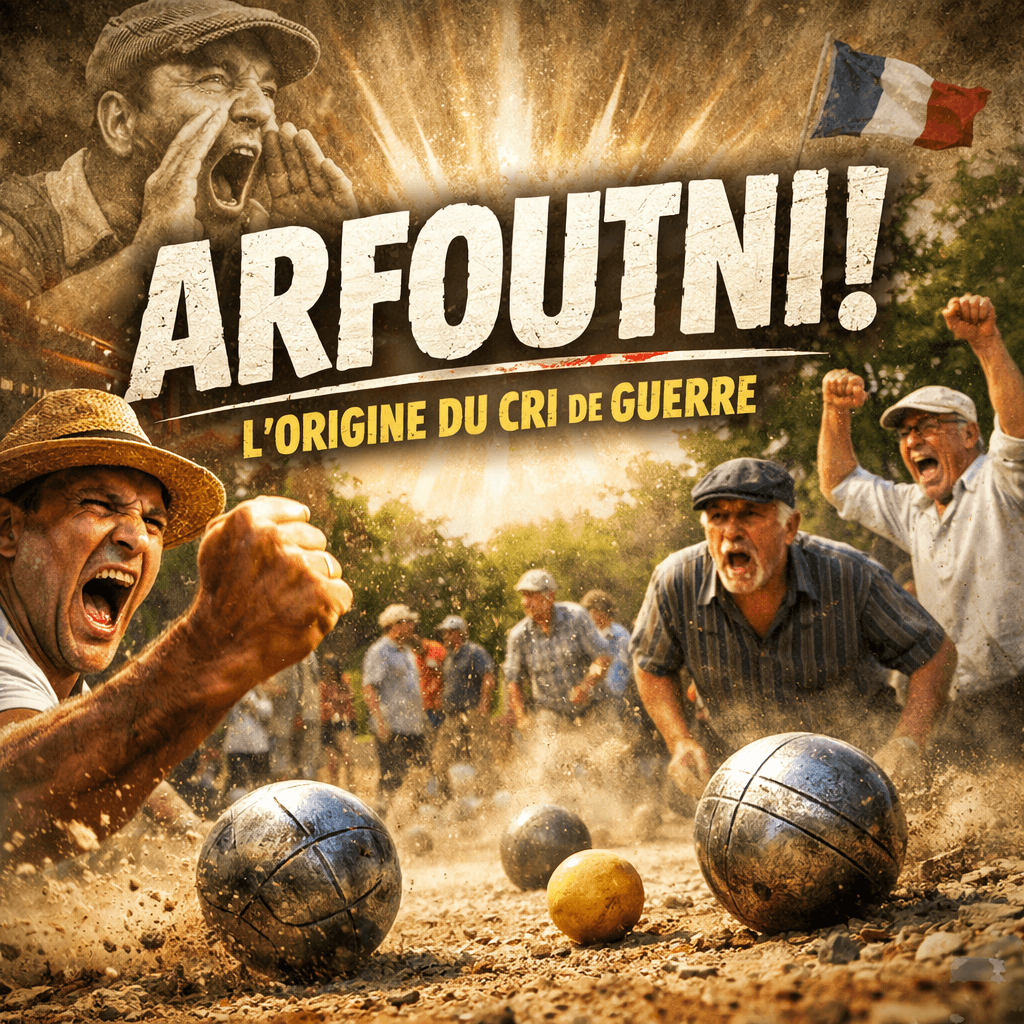
Arfoutni: The secret origin of the pétanque war cry
There are words that do not need translation for those who play pétanque. Arfoutni is one of them. You heard it. You may have shouted it yourself without really knowing why or where it came from. This cry of satisfaction - springing up spontaneously when a ball achieves what was asked of it - is one of the most characteristic expressions of the world of ball. And yet, ask ten players what it really means: you will get ten different answers, nine of which are correct.The etymology — breaking down the word
Arfoutni is not a word invented on a boulodrome one Sunday afternoon. It's a phonetic contraction derived from Provençal and Occitan — two Romance languages spoken in the south of France for centuries, which have left deep marks on the region's everyday vocabulary, including on pétanque courts.
🔬 ETYMOLOGICAL BREAKDOWN AR- Provençal / Occitan Intensive prefix of Latin origin (ad-) signalling the completion of an action, or its completeness. "Well", "truly", "totally". + FOUTU Colloquial French / Occitan foutre From Latin futuere — in the colloquial sense of "done", "sorted", "accomplished". "C'est foutu" can mean ruined — but also definitively resolved. + -NI Occitan suffix A reinforcing suffix found in many Provençal interjections. It sharpens the exclamation and gives it a definitive, unambiguous character. ↓ ARFOUTNI "Well done!" — "Perfectly accomplished!" — "That's sorted!"The formation of the word follows a logic that is very common in southern Romance languages: take a simple idea (something is done, accomplished, successful), prefix it to intensify it, and suffix it to give it an exclamatory character. The phonetic result is a short, rhythmic word that comes out naturally from a mouth in a state of excitement or satisfaction — exactly what a pétanque player needs at the moment their boule has just done exactly what they asked of it.
The Occitan roots — the language behind the expression
📚 LINGUISTIC CONTEXT Occitan: the mother tongue of the South's boulodromes Occitan — or langue d'oc — is a Romance language spoken in the southern third of France since the Middle Ages. At its peak, it was the language of troubadour poetry and the common tongue of the entire area from Aquitaine to Provence. Even though it gradually gave way to French as the official language from the 16th century onwards, its expressions, intonations and vocabulary survived in the regional French of the South.Pétanque, born in La Ciotat in Provence at the start of the 20th century, developed in a cultural setting that was entirely Occitan-speaking — or at any rate in a setting where Occitan and Provençal had deeply shaped everyday speech. The first players, the first spectators, the first commentators of games were men of the South whose natural language blended French with expressions drawn directly from Occitan. Game cries emerged from this bilingual culture, spontaneously, with no academy and no dictionary. 🔤 LINGUISTIC NOTE — The word foutre in Occitan In Provençal Occitan, the verb foutre (derived from Latin futuere) had a much broader meaning than in modern French. It meant "to do", "to accomplish", "to put", "to settle" — with a connotation of completeness and effectiveness. "Foutre" a boule near the jack, that was putting it there, placing it there with a sense of completion. When something was "foutu" in this Occitan sense, it wasn't a miss — it was definitively accomplished. It's this reversal of meaning compared to modern French that explains why arfoutni is an exclamation of satisfaction and not of defeat. A language carries the history of its speakers.
What the word really means — the nuance everyone misses
The most common translation players give is "it's in the bag" or "it's won". That's approximate. The real meaning is finer — and more interesting.
Arfoutni doesn't mean "we've won" — the score can still swing. It means precisely: "the action I had to take is accomplished perfectly and definitively." It's a statement about the act, not about the result. "That shot is done. That boule is placed. What I could control, I controlled." What follows — winning the end or not — no longer belongs to the player but to circumstance. Arfoutni is the dividing line between what you master and what you no longer master. — Paquita's interpretation, based on interviews with Occitan-loving speakers from the Var and the Bouches-du-RhôneThis nuance changes everything about understanding the expression. You can shout arfoutni on a missed shot if the action was perfect — the boule did what was asked of it but the ground betrayed it. You can also refrain from shouting it on a successful shot if you know the success was accidental. It's a judgement on the quality of the execution, not on the immediate result.
🎙️ Paquita on the deeper meaning "I grew up hearing this word without ever really analysing it — the way a child hears 'allez' at football or 'merde' at the theatre without looking for the etymology. It was when I started taking an interest in Occitan that I understood what the old players were really shouting. Not 'we've won'. Not 'it's in the bag'. Something far more beautiful: 'I did what I had to do'. It's a craftsman's declaration as he looks at his work and says — that's good, it's done. What fate does with it is another matter." — PaquitaHow it travelled from Provence to all of France
Early 20th century — La Ciotat, Provence Born in the mouths of the first players The first pétanque players are workers, fishermen, shopkeepers of the Provençal coast, whose everyday speech is steeped in Occitan. Game cries emerge naturally from this language: arfoutni, couquin, buto... They aren't invented — they're the natural words that burst out when emotion gets the upper hand over linguistic reflection. 1920s–1940s — Regional spread From the coast to the inland, from the Var to the Bouches-du-Rhône Pétanque spreads rapidly across the entire South — Var, Bouches-du-Rhône, Vaucluse, Gard, Hérault. All these regions share a living Occitan culture. Arfoutni travels with the players, adapts phonetically to local accents, generates variants: arfoutu in the Rhône valley, arfouti towards Languedoc. The word is already a family. 1950s–1970s — Rural exodus and holidays Southern players head up to Paris (and everywhere else) The post-war rural exodus and migration flows carry the cultural practices of the South to every French region. Pétanque players go with their boules — and with their vocabulary. In the Parisian, Lyonnais and Bordeaux suburbs, players from the South play and shout arfoutni. Local players, taken with the word, adopt it without trying to understand its origin. 1970s–1990s — Television and the media Pétanque in living rooms, and its vocabulary with it Television broadcasts of the world championships — since their first media coverage — show Southern players shouting their natural expressions. Sports commentators pick them up, sometimes with an explanation, often without. Arfoutni enters French popular culture as "a pétanque word" without most viewers knowing where it comes from. Today — Cultural heritage A word that outlives the language that produced it Occitan is today a minority language that many young Southerners no longer speak. But arfoutni survives in boulodromes across the entire country — a linguistic survival carried not by academies but by playing grounds and cafés. It's the popular vitality of a word that far outlasts the language that created it.The regional variants
Arfoutni is the most widespread form — but it isn't the only one. As pétanque travelled through regions with different linguistic traditions, the expression evolved phonetically while keeping the same meaning.
📍 Provence — Var, B.-du-Rhône ARFOUTNI / ar-fu-tni /The original form, the closest to the Occitan construction. The -ni final is pronounced distinctly, sometimes even doubled in strong emotion: "arfoutni-ni!"
📍 Rhône Valley, Drôme ARFOUTU / ar-fu-tu /Variant with an ending in -u, closer to standard French. Same structure, same meaning — simply adapted to the less pronounced accent of the transition zones between the South and the centre.
📍 Languedoc, Hérault ARFOUTI / ar-fu-ti /A Languedoc variant. The suffix -i is characteristic of western Languedoc inflections, different from the eastern Provençal from which the form in -ni.
📍 Gascony, Gers ENFOUTU / ɑ̃-fu-tu /A Gascon variant with the prefix en- instead of ar-. Gascon is a variety of Occitan with its own phonetic characteristics, notably the different treatment of the f- initial Latin.
📍 North, Île-de-France (adoption) C'EST FOUTU / sɛ fu-tu /In non-Occitan-speaking regions, the expression has often been simplified to "c'est foutu!" — which is phonetically close but completely loses the Occitan intensive prefix and exclamatory suffix.
📍 International — Belgium, Switzerland ARFOUTNI / ar-fu-tni /The pétanque communities of Belgium and French-speaking Switzerland have adopted the original Provençal form, imported directly by clubs from the South. The globalisation of pétanque is standardising the expression.
When do you say arfoutni? — the exact situations
The word isn't interchangeable with just any expression of satisfaction. There are specific situations where it's natural, and others where using it would be odd or inappropriate.
🎯 The perfectly placed point — the classic situation The pointer's boule stops 5 cm from the jack, exactly at the intended spot, after a perfect flight and bounce. This is the canonical situation — the action was executed exactly as planned. The execution is complete and flawless. "The boule leaves the hand, bounces right where it had to, rolls three centimetres, stops. Arfoutni!" 💥 The perfect carreau — a shot that hits exactly The shooter takes aim, the impact lands exactly on the opposing boule, the opposing boule goes out, theirs takes its place. The execution was precisely the one planned. Arfoutni can be shouted by the shooter, their team, or even the spectators who recognise the quality of the action. "The iron hits dead centre. Opposing boule out. Theirs stays. Arfoutni!" 🎪 The successful difficult shot — when the action exceeds expectations An awkward boule, a difficult angle, an unusual distance — and the player pulls off exactly what was asked of them. The exclamation here expresses both the exceptional quality of the action and the satisfaction of having pulled it off under pressure. "No one thought he could pass between the two boules at 9 metres. He did it. Arfoutni!" 🤝 In recognition of the opponent's action — a fair-play usage One of the finest and least-known uses: saying arfoutni after a fine action by the opponent. It's not flattery — it's the sincere recognition of a perfect execution, whichever team produced it. It's a mark of authentic pétanque culture. "The opponent plays a magnificent carreau. \"Arfoutni!\" says the opposing captain. And everyone understands it's a sincere compliment." 🚫 What arfoutni does NOT mean — incorrect uses You don't say arfoutni when you've been lucky (a fortunate bounce, a favourable ground). Nor do you say it to score an ordinary point on a normal boule. And above all, you don't use it as provocation or mockery towards the opponent — that isn't its meaning. The ironic or sarcastic use ofarfoutni betrays a cultural ignorance of the word. "Shouting arfoutni after a lucky point or an ordinary shot is like using a big word for a small idea."Other pétanque expressions and their origin
Arfoutni isn't alone. The boulodrome has its own lexicon, much of it inherited from Occitan and Provençal. A quick tour of the most common expressions and what they really mean.
| Expression | Origin | Literal meaning | Current usage |
|---|---|---|---|
| Arfoutni | Occitan — ar- + foutu + -ni | "It's perfectly accomplished!" | A cry of satisfaction after a fine technical action |
| Buto | Provençal — buto (the target, the jack) | "The jack" / "The target" | Name for the jack in Provençal areas. Still used by older players. |
| Couquin / Coquin | Occitan — coqí (rogue, sly) | "The rogue!" (a boule that's hard to dislodge) | An exclamation at a well-placed boule that's hard to reach |
| Fanny | Regional French — uncertain origin (see dedicated article) | A proper name that became a ritual | A 13-0 defeat and its ritual — see our full article |
| Maou | Provençal — mau (bad) | "Bad!" / "Missed!" | An exclamation at a missed shot or a bad bounce. Still going strong in Provence. |
| Pétanque | Provençal — pès tancats | "Feet together" / "Feet fixed" | The very name of the sport — which describes the position of the feet in the circle at the moment of the throw |
| Carreau | French — from Latin quadratus | "Square" — an object that stays in place after displacing | A shot that displaces the opposing boule and stays in its place. The most highly valued shot. |
| Mène | French / Occitan — mena (leading) | "That which is driven" — play from one end to the other | Term designating each "round" of a pétanque game |
The very name of the sport — pétanque — comes from Provençal pès tancats, literally "feet together" or "feet fixed". It's a direct reference to the founding rule that distinguishes pétanque from longue paume: the feet stay still in the circle throughout the throw. The sport named itself after its main rule — in Occitan.
Why this word survives when the language dies
Occitan is today an endangered language. Fewer than 10% of the inhabitants of the South of France speak it fluently, and that proportion shrinks from generation to generation. And yet, arfoutni is shouted every day on boulodromes across the whole of France — including by players who don't know it's Occitan, who couldn't give its literal meaning, who have never learned a single other word of that language.
This phenomenon of lexical survival isn't exceptional. Certain words resist the disappearance of their language of origin because they fulfil a function that their substitute language doesn't perform as well. Arfoutni says in one second, with the accent and the emotion, something that no standard French expression manages to condense as effectively. "That's good!", "Bravo!", "Great!" — none of these exclamations carries the precise nuance of perfect and definitively accomplished execution that arfoutni.
🗺️ Pétanque, the unwitting guardian of OccitanThe boulodromes of the South are, without having sought it, among the last spaces where Occitan is expressed naturally — even in the form of lexical survivals. Arfoutni, buto, couquin... These words keep living because the game carries them, because the emotion of the action demands those precise sounds. Pétanque didn't save Occitan — but it has preserved some of its liveliest expressions, the ones that are born when emotion is too strong to be contained in the official language.
📖 PAQUITA'S BOOK To have more occasion to shout arfoutniKnowing the origin of the word is good. Having an action that justifies it is better. Paquita's book gives the method to ingrain a repeatable shot or point — 100 numbered exercises, programmes by level, mental and technical.
📦 Order on AmazonFAQ — Your frequent questions
Quelle est la bonne orthographe — arfoutni, ar-fouti, arfoutu ? + Il n'existe pas d'orthographe officielle — le mot n'a jamais été normalisé ni enregistré dans un dictionnaire de référence français. On trouve les graphies arfoutni, ar fouti, arfoutu, ar foutu depending on the regions and the authors who have mentioned it in writings on pétanque. The spelling arfoutni est la plus courante et la plus proche de la prononciation provençale d'origine. C'est celle qu'utilise PétanqueLand par convention, mais aucune autorité linguistique ne vous sanctionnera pour les autres. Est-ce qu'on peut dire arfoutni même si on ne parle pas occitan ? + Absolument — et c'est d'ailleurs ce que fait la grande majorité des joueurs qui utilisent le mot. L'expression a depuis longtemps dépassé le cadre de sa langue d'origine pour devenir un mot du vocabulaire pétanque français. Ne pas parler occitan ne vous empêche pas de crier arfoutni sur un beau tir, de la même façon que ne pas parler anglais ne vous empêche pas de dire "cool" ou "ok". Les mots voyagent, s'émancipent de leurs langues et trouvent leur vie propre dans les usages. Le mot est-il utilisé dans d'autres sports ou contextes que la pétanque ? + Dans le sud de la France, des variantes de l'expression — notamment arfoutu — s'utilisent dans d'autres contextes de satisfaction : après une réparation réussie, en cuisine quand un plat est bien réussi, à la pêche après une belle prise. Mais c'est la pétanque qui lui a donné sa notoriété nationale. Hors du Sud, le mot est quasi-exclusivement associé à la pétanque — ce qui confirme que c'est le sport qui l'a véhiculé dans tout le pays. Y a-t-il d'autres mots de la pétanque d'origine occitane à connaître ? + Yes, several. Buto (the jack, still used in the Var and the Bouches-du-Rhône) comes directly from Occitan buto. Couquin (an exclamation at a boule that's hard to dislodge) comes from Provençal. The word pétanque itself, let's recall, comes from Provençal pès tancats (feet fixed). And several expressions like maou (mauvais, raté) sont encore vivantes dans les clubs du Midi. La pétanque est linguistiquement une création occitane autant que sportive. Est-ce qu'arfoutni est cité dans des dictionnaires ou des livres officiels ? + L'expression n'apparaît ni dans le Larousse ni dans le Robert en tant qu'entrée principale — ce qui confirme son statut de mot populaire jamais normalisé. On en trouve des mentions dans des ouvrages régionaux consacrés au vocabulaire provençal et dans des publications sportives sur la pétanque. Le Trésor de la Langue Française informatisé (CNRS) ne l'enregistre pas non plus, mais enregistre foutre in its regional popular senses. The best documentation on the word remains, paradoxically, the boulodromes themselves — where it lives in a way that no dictionary has yet truly captured. 📎 Related articles Rules FFPJP Rules — the real rules of the game Culture The end of the hidden jack — why it changed PétanqueLand All the pétanque news Video Refereeing videos — commented situations Equipment Choosing your boules 2026 — complete guide Tools Free PetanqueLand tools© Pétanque by Paquita — petanqueland.fr ·
📖 Paquita's book on Amazon
Sources: linguistic works on Provençal Occitan, interviews with speakers from the Var and the Bouches-du-Rhône, regional publications on pétanque vocabulary. The etymology presented here is the best documented and the most widely shared among specialists — other hypotheses exist, none is contradicted by observed usage.