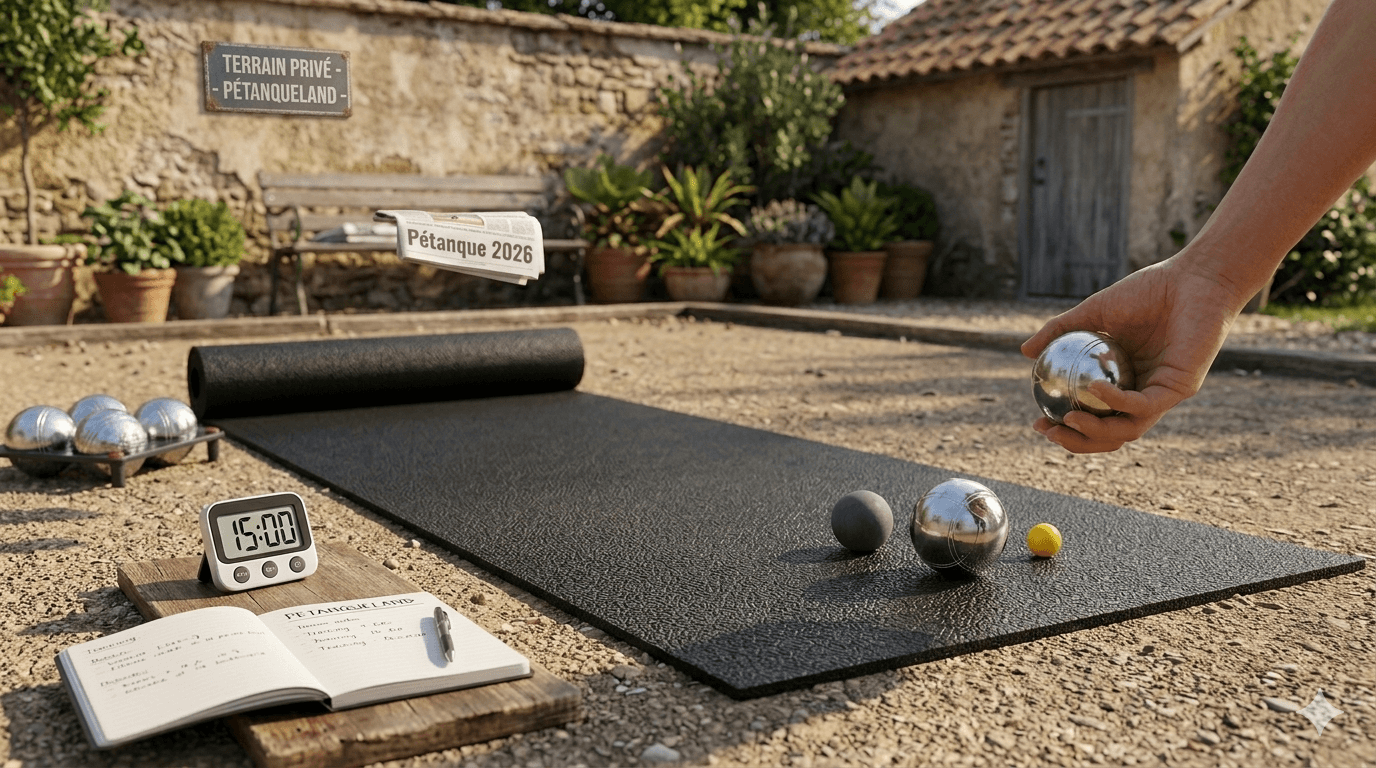
PetanqueLand
Search: Movie should be distinctly Please enter a search term in the search field.

Not to be missed

Search suggestions

Why do some boules veer off for no apparent reason? (Pétanque) Article Why do some boules veer off for no apparent reason in pétanque? PAQUITA ON PÉTANQUE STRIKE Video Pétanque: when you celebrate too soon… Video pourquoi il ne faut jamais celebrer avent la (1)-Couverture Boule diameter: why the wrong choice holds you back (Pétanque) Article Which boule diameter should you choose? The direct impact on your performance THE DIGESTION EXCUSE Video
Cart 0
EN▾
FrançaisEnglishEspañolItalianoDeutschPortuguêsNederlandsCatalàالعربية中文ไทย
PetanqueLand
  • Home
  • SHOP
    • Pétanque Book Shop
    • Pétanque Player Clothing
    • Pétanque Objects & Decor
    • Pétanque Gift Ideas
    • See all
  • ⭐ The Pétanque Software
  • Videos
  • 🏛️ OFFICIAL
    • Upcoming competitions
    • Results & calendar
    • Rules explained
  • FREE Zone
    • Free online software
    • Free tools
    • Lab
  • News by Paquita
Total articles: 193
:root { --noir: #0d0d0d; --noir-2: #141414; --card: #161616; --card-2: #1d1d1d; --border: #282828; --jaune: #f5c800; --jaune-dim: rgba(245,200,0,.08); --blanc: #f0ede6; --gris: #888; --gris-2: #aaa; --rouge: #e03030; --rouge-dim: rgba(224,48,48,.08); --orange: #f07020; --orange-dim: rgba(240,112,32,.1); --vert: #42c264; --vert-dim: rgba(66,194,100,.1); --bleu: #4aa8e0; --bleu-dim: rgba(74,168,224,.1); --cyan: #20c8a0; --cyan-dim: rgba(32,200,160,.1); } *, *::before, *::after { box-sizing: border-box; margin: 0; padding: 0; } html { scroll-behavior: smooth; } body { background: var(--noir); color: var(--blanc); font-family: 'Barlow', sans-serif; font-size: 17px; line-height: 1.8; -webkit-font-smoothing: antialiased; } a { color: var(--jaune); text-decoration: none; } a:hover { text-decoration: underline; } strong { color: #eee; } p { margin-bottom: 16px; color: #bbb; } em { color: #ccc; font-style: italic; } /* ─── HERO ─── */ .hero { position: relative; background: var(--noir-2); border-bottom: 3px solid var(--jaune); padding: 80px 24px 64px; text-align: center; overflow: hidden; } .hero::before { content: ''; position: absolute; inset: 0; background: radial-gradient(ellipse 70% 55% at 50% 0%, rgba(32,200,160,.12), transparent 68%); pointer-events: none; } .hero-tag { display: inline-flex; align-items: center; gap: 7px; background: var(--cyan); color: var(--noir); font-family: 'Bebas Neue', sans-serif; font-size: 13px; letter-spacing: 2px; padding: 5px 14px; border-radius: 2px; margin-bottom: 22px; } .hero h1 { font-family: 'Bebas Neue', sans-serif; font-size: clamp(2.2rem, 6.5vw, 4rem); letter-spacing: 1.5px; line-height: 1.05; color: var(--blanc); max-width: 880px; margin: 0 auto 16px; } .hero h1 em { color: var(--jaune); font-style: normal; } .hero-sub { font-size: 1rem; color: #888; font-style: italic; max-width: 620px; margin: 0 auto 14px; } .hero-meta { display: flex; justify-content: center; gap: 20px; flex-wrap: wrap; color: var(--gris); font-size: .88rem; margin-top: 12px; } .hero-meta span::before { content: '• '; } .hero-meta span:first-child::before { content: ''; } /* ─── LAYOUT ─── */ .page-wrap { max-width: 860px; margin: 0 auto; padding: 60px 24px 100px; } /* ─── INTRO ─── */ .intro-box { background: var(--card); border-left: 5px solid var(--cyan); border-radius: 0 8px 8px 0; padding: 22px 26px; margin-bottom: 48px; font-size: 1.05rem; color: #bbb; } /* ─── CHIFFRES CLÉS ─── */ .key-facts { display: grid; grid-template-columns: repeat(4, 1fr); gap: 0; margin-bottom: 48px; border: 1px solid var(--border); border-radius: 10px; overflow: hidden; } @media(max-width:540px){ .key-facts { grid-template-columns: 1fr 1fr; } } .kf-item { padding: 20px 12px; text-align: center; background: var(--card-2); border-right: 1px solid var(--border); } .kf-item:last-child { border-right: none; } .kf-val { font-family: 'Bebas Neue', sans-serif; font-size: 2.2rem; color: var(--cyan); line-height: 1; margin-bottom: 5px; } .kf-unit { font-size: .7rem; color: #555; text-transform: uppercase; letter-spacing: 1px; } .kf-label { font-size: .76rem; color: #777; line-height: 1.3; margin-top: 2px; } /* ─── TOC ─── */ .toc { background: var(--card); border: 1px solid var(--border); border-top: 3px solid var(--cyan); border-radius: 0 0 8px 8px; padding: 22px 26px; margin-bottom: 52px; } .toc-title { font-family: 'Bebas Neue', sans-serif; font-size: 1rem; letter-spacing: 2px; color: var(--cyan); margin-bottom: 14px; } .toc ol { padding-left: 20px; color: var(--gris-2); font-size: .93rem; line-height: 2.1; } .toc ol li a { color: var(--gris-2); } .toc ol li a:hover { color: var(--jaune); } /* ─── HEADINGS ─── */ h2 { font-family: 'Bebas Neue', sans-serif; font-size: clamp(1.7rem, 4vw, 2.4rem); color: var(--jaune); letter-spacing: 1px; margin: 60px 0 22px; display: flex; align-items: center; gap: 12px; } h2::before { content: ''; display: inline-block; width: 6px; height: 32px; background: var(--cyan); border-radius: 2px; flex-shrink: 0; } /* ─── EXERCICE CARD PRINCIPALE ─── */ .exo-card { background: var(--card-2); border: 1px solid var(--border); border-radius: 14px; overflow: hidden; margin: 32px 0; } .exo-header { padding: 22px 26px 18px; display: flex; align-items: flex-start; gap: 18px; border-bottom: 1px solid var(--border); } .exo-numero { font-family: 'Bebas Neue', sans-serif; font-size: 4rem; line-height: 1; flex-shrink: 0; width: 64px; text-align: center; } .exo-1 .exo-numero { color: var(--cyan); } .exo-2 .exo-numero { color: var(--vert); } .exo-3 .exo-numero { color: var(--orange); } .exo-meta { flex: 1; } .exo-nom { font-family: 'Bebas Neue', sans-serif; font-size: 1.6rem; letter-spacing: 1.5px; color: var(--blanc); line-height: 1.1; margin-bottom: 8px; } .exo-tags { display: flex; flex-wrap: wrap; gap: 7px; } .exo-tag { display: inline-flex; align-items: center; gap: 5px; padding: 3px 10px; border-radius: 4px; font-size: .78rem; font-weight: 700; letter-spacing: .5px; } .tag-lieu { background: var(--bleu-dim); color: var(--bleu); } .tag-temps { background: var(--jaune-dim); color: var(--jaune); } .tag-niv-1 { background: var(--cyan-dim); color: var(--cyan); } .tag-niv-2 { background: var(--vert-dim); color: var(--vert); } .tag-niv-3 { background: var(--orange-dim); color: var(--orange); } .tag-mat { background: rgba(255,255,255,.04); color: #777; border: 1px solid #2a2a2a; } .exo-body { padding: 24px 26px; } /* ─── OBJECTIF BOX ─── */ .objectif-box { background: var(--card); border-left: 4px solid var(--cyan); border-radius: 0 8px 8px 0; padding: 14px 18px; margin-bottom: 22px; font-size: .93rem; color: #aaa; } .exo-2 .objectif-box { border-left-color: var(--vert); } .exo-3 .objectif-box { border-left-color: var(--orange); } .objectif-label { font-family: 'Bebas Neue', sans-serif; font-size: .8rem; letter-spacing: 2px; color: var(--cyan); margin-bottom: 4px; } .exo-2 .objectif-label { color: var(--vert); } .exo-3 .objectif-label { color: var(--orange); } /* ─── SETUP VISUEL ─── */ .setup-schema { background: var(--card); border: 1px solid var(--border); border-radius: 10px; padding: 20px; margin: 20px 0; text-align: center; } .setup-title { font-family: 'Bebas Neue', sans-serif; font-size: .82rem; letter-spacing: 2px; color: #555; margin-bottom: 16px; } .setup-terrain { position: relative; height: 90px; background: #0f1a0f; border: 1px solid #1a2a1a; border-radius: 8px; margin-bottom: 12px; overflow: hidden; } .setup-terrain::before { content: ''; position: absolute; inset: 0; background: repeating-linear-gradient(90deg, transparent, transparent 30px, rgba(255,255,255,.02) 30px, rgba(255,255,255,.02) 31px); } /* marquages terrain */ .t-cercle { position: absolute; left: 8%; top: 50%; transform: translateY(-50%); width: 24px; height: 24px; border-radius: 50%; border: 2px solid var(--jaune); display: flex; align-items: center; justify-content: center; font-size: .55rem; color: var(--jaune); font-weight: 700; } .t-cible { position: absolute; top: 50%; transform: translateY(-50%); width: 14px; height: 14px; border-radius: 50%; } .t-zone { position: absolute; top: 20%; height: 60%; border: 1px dashed rgba(255,255,255,.15); border-radius: 4px; } .t-label { position: absolute; font-size: .6rem; color: #555; white-space: nowrap; } .t-fleche { position: absolute; top: 50%; transform: translateY(-50%); color: #444; font-size: .8rem; } .setup-legende { display: flex; justify-content: center; gap: 18px; flex-wrap: wrap; font-size: .75rem; color: #555; } .setup-leg-item { display: flex; align-items: center; gap: 6px; } .leg-dot { width: 10px; height: 10px; border-radius: 50%; } /* ─── ÉTAPES ─── */ .etapes { display: flex; flex-direction: column; gap: 12px; margin: 16px 0; counter-reset: etape; } .etape-item { background: var(--card); border: 1px solid var(--border); border-radius: 8px; padding: 14px 16px 14px 56px; position: relative; counter-increment: etape; } .etape-item::before { content: counter(etape); position: absolute; left: 14px; top: 50%; transform: translateY(-50%); width: 28px; height: 28px; border-radius: 50%; display: flex; align-items: center; justify-content: center; font-family: 'Bebas Neue', sans-serif; font-size: 1rem; color: var(--noir); } .exo-1 .etape-item::before { background: var(--cyan); } .exo-2 .etape-item::before { background: var(--vert); } .exo-3 .etape-item::before { background: var(--orange); } .etape-item p { font-size: .9rem; color: #aaa; margin-bottom: 0; line-height: 1.6; } .etape-item strong { color: #ddd; } /* ─── VARIANTES ─── */ .variantes { background: var(--card); border: 1px solid var(--border); border-radius: 8px; padding: 16px 18px; margin-top: 18px; } .var-label { font-family: 'Bebas Neue', sans-serif; font-size: .82rem; letter-spacing: 2px; color: var(--gris); margin-bottom: 10px; } .var-list { list-style: none; display: flex; flex-direction: column; gap: 6px; } .var-list li { font-size: .86rem; color: #888; padding-left: 16px; position: relative; line-height: 1.5; } .var-list li::before { content: '↳'; position: absolute; left: 0; color: #444; } /* ─── SCORE / SUIVI ─── */ .score-wrap { background: var(--card); border: 1px solid var(--border); border-radius: 8px; padding: 16px 18px; margin-top: 18px; display: flex; gap: 20px; align-items: flex-start; flex-wrap: wrap; } .score-ico { font-size: 1.6rem; flex-shrink: 0; } .score-content { flex: 1; min-width: 180px; } .score-label { font-family: 'Bebas Neue', sans-serif; font-size: .82rem; letter-spacing: 2px; color: var(--jaune); margin-bottom: 6px; } .score-grille { display: flex; gap: 6px; flex-wrap: wrap; } .score-case { width: 28px; height: 28px; border-radius: 5px; border: 1px solid var(--border); background: var(--card-2); display: flex; align-items: center; justify-content: center; font-size: .7rem; color: #444; } .score-baremes { font-size: .82rem; color: #666; line-height: 1.7; margin-top: 8px; } .score-baremes strong { color: #999; } /* ─── CHRONO TIMER ─── */ .chrono-strip { display: flex; align-items: center; gap: 0; border: 1px solid var(--border); border-radius: 8px; overflow: hidden; margin: 20px 0; } .chrono-bloc { flex: 1; padding: 12px 8px; text-align: center; background: var(--card-2); border-right: 1px solid var(--border); position: relative; } .chrono-bloc:last-child { border-right: none; } .chrono-bloc.actif-1 { background: rgba(32,200,160,.08); } .chrono-bloc.actif-2 { background: rgba(66,194,100,.08); } .chrono-bloc.actif-3 { background: rgba(240,112,32,.08); } .ch-min { font-family: 'Bebas Neue', sans-serif; font-size: 1.6rem; line-height: 1; margin-bottom: 3px; } .chrono-bloc.actif-1 .ch-min { color: var(--cyan); } .chrono-bloc.actif-2 .ch-min { color: var(--vert); } .chrono-bloc.actif-3 .ch-min { color: var(--orange); } .ch-label { font-size: .72rem; color: #555; line-height: 1.4; } /* ─── PRINCIPES DU POINT ─── */ .principes-grid { display: grid; grid-template-columns: repeat(auto-fill, minmax(200px, 1fr)); gap: 12px; margin: 28px 0; } .principe-card { background: var(--card-2); border: 1px solid var(--border); border-radius: 10px; padding: 18px 16px; border-top: 3px solid var(--cyan); } .pr-ico { font-size: 1.8rem; margin-bottom: 8px; display: block; } .pr-titre { font-family: 'Bebas Neue', sans-serif; font-size: .95rem; letter-spacing: 1.5px; color: var(--cyan); margin-bottom: 5px; } .principe-card p { font-size: .84rem; color: #888; margin-bottom: 0; line-height: 1.55; } /* ─── CHECK-LIST ─── */ .check-list { list-style: none; margin: 16px 0; display: flex; flex-direction: column; gap: 8px; } .check-list li { display: flex; align-items: flex-start; gap: 10px; font-size: .92rem; color: #bbb; padding: 10px 14px; background: var(--card-2); border: 1px solid var(--border); border-radius: 6px; line-height: 1.5; } .check-list li .ci { flex-shrink: 0; font-size: 1rem; margin-top: 1px; } /* ─── PAQUITA TIP ─── */ .paquita-tip { background: var(--jaune-dim); border: 1px solid rgba(245,200,0,.2); border-left: 5px solid var(--jaune); border-radius: 0 10px 10px 0; padding: 20px 24px; margin: 28px 0; display: flex; gap: 16px; align-items: flex-start; } .paquita-tip .pt-emo { font-size: 2rem; flex-shrink: 0; } .paquita-tip .pt-label { font-family: 'Bebas Neue', sans-serif; font-size: .95rem; letter-spacing: 2px; color: var(--jaune); margin-bottom: 6px; } .paquita-tip p { font-size: .93rem; color: #ccc; margin-bottom: 0; } /* ─── DIALOGUE PAQUITA ─── */ .dialogue-paquita { background: var(--card-2); border: 1px solid var(--border); border-radius: 10px; padding: 22px 24px; margin: 28px 0; } .dp-label { font-family: 'Bebas Neue', sans-serif; font-size: .82rem; letter-spacing: 2px; color: var(--cyan); margin-bottom: 10px; } .dp-text { font-size: 1.02rem; font-style: italic; color: #ccc; line-height: 1.7; border-left: 4px solid var(--jaune); padding-left: 16px; } .dp-sign { font-family: 'Bebas Neue', sans-serif; font-size: .85rem; letter-spacing: 2px; color: var(--jaune); margin-top: 12px; } /* ─── INFO STRIP ─── */ .info-strip { background: var(--card); border: 1px solid var(--border); border-left: 5px solid var(--bleu); border-radius: 0 8px 8px 0; padding: 16px 22px; margin: 28px 0; display: flex; gap: 14px; align-items: flex-start; } .info-strip .emo { font-size: 1.6rem; flex-shrink: 0; padding-top: 2px; } .info-strip p { font-size: .93rem; color: #aaa; margin-bottom: 0; } /* ─── ALERT ─── */ .alert-box { background: var(--rouge-dim); border: 1px solid rgba(224,48,48,.22); border-left: 5px solid var(--rouge); border-radius: 0 8px 8px 0; padding: 18px 22px; margin: 28px 0; } .alert-label { font-family: 'Bebas Neue', sans-serif; font-size: .95rem; letter-spacing: 2px; color: var(--rouge); margin-bottom: 8px; } .alert-box p { font-size: .93rem; color: #ccc; margin-bottom: 0; } /* ─── PLANNING HEBDO ─── */ .planning-wrap { display: grid; grid-template-columns: repeat(7, 1fr); gap: 0; margin: 28px 0; border: 1px solid var(--border); border-radius: 10px; overflow: hidden; } @media(max-width:560px){ .planning-wrap { grid-template-columns: repeat(4, 1fr); } } .plan-jour { padding: 14px 6px; text-align: center; background: var(--card-2); border-right: 1px solid var(--border); } .plan-jour:last-child { border-right: none; } .plan-nom { font-family: 'Bebas Neue', sans-serif; font-size: .75rem; letter-spacing: 1px; margin-bottom: 6px; } .plan-ico { font-size: 1.3rem; margin-bottom: 4px; display: block; } .plan-desc { font-size: .65rem; color: #555; line-height: 1.4; } .plan-jour.actif-1 { background: rgba(32,200,160,.08); } .plan-jour.actif-2 { background: rgba(66,194,100,.08); } .plan-jour.actif-3 { background: rgba(240,112,32,.08); } .plan-jour.actif-1 .plan-nom { color: var(--cyan); } .plan-jour.actif-2 .plan-nom { color: var(--vert); } .plan-jour.actif-3 .plan-nom { color: var(--orange); } .plan-jour.repos .plan-nom { color: #3a3a3a; } /* ─── FAQ ─── */ .faq { margin: 28px 0; } .faq-item { background: var(--card-2); border: 1px solid var(--border); border-radius: 8px; margin-bottom: 10px; overflow: hidden; } .faq-q { width: 100%; background: none; border: none; color: var(--blanc); font-family: 'Barlow', sans-serif; font-size: .97rem; font-weight: 600; text-align: left; padding: 16px 20px; cursor: pointer; display: flex; justify-content: space-between; align-items: center; gap: 10px; } .faq-icon { flex-shrink: 0; width: 22px; height: 22px; border-radius: 50%; background: var(--jaune); color: var(--noir); display: flex; align-items: center; justify-content: center; font-size: 16px; font-weight: 900; transition: transform .25s; } .faq-item.open .faq-icon { transform: rotate(45deg); } .faq-a { max-height: 0; overflow: hidden; transition: max-height .3s ease; } .faq-item.open .faq-a { max-height: 700px; } .faq-a-inner { padding: 0 20px 18px; font-size: .92rem; color: #999; } .faq-a-inner a { color: var(--jaune); } /* ─── RELATED ─── */ .related-title { font-family: 'Bebas Neue', sans-serif; font-size: 1.8rem; color: var(--jaune); letter-spacing: 1px; margin: 60px 0 22px; display: flex; align-items: center; gap: 12px; } .related-title::before { content: ''; display: inline-block; width: 6px; height: 28px; background: var(--cyan); border-radius: 2px; } .related-grid { display: grid; grid-template-columns: repeat(auto-fill, minmax(240px,1fr)); gap: 12px; margin-bottom: 52px; } .rel-card { background: var(--card); border: 1px solid var(--border); border-radius: 8px; padding: 16px 18px; display: block; transition: border-color .2s, background .2s; } .rel-card:hover { border-color: var(--jaune); background: #1a1a1a; text-decoration: none; } .rel-cat { font-size: .75rem; font-weight: 700; letter-spacing: 1.5px; text-transform: uppercase; color: var(--jaune); margin-bottom: 6px; display: block; } .rel-card .rel-title { font-size: .95rem; color: #ddd; font-weight: 600; line-height: 1.4; } /* ─── FOOTER ─── */ .art-footer { border-top: 1px solid #222; padding-top: 28px; text-align: center; color: #555; font-size: .85rem; } .art-footer a { color: var(--jaune); }
🎯 Home training

3 exercises of 15 minutes
for pointing at home

Living room, hallway, garden — no need for a boulodrome to anchor the gesture. Just 15 minutes, one boule, and rigor. Pétanque technique Pointing By Paquita Reading: 7 min
Le pointeur progresse entre les parties, pas seulement pendant. Le problème : on ne peut pas aller au boulodrome tous les jours. La solution : certaines dimensions fondamentales du pointage s'entretiennent très bien à la maison — le geste de pendule, la régularité de lâcher, la lecture de la trajectoire. Ces trois exercices de 15 minutes ciblent chacun une faiblesse classique du pointeur amateur. Vous pouvez les faire séparément ou les enchaîner dans une session de 45 minutes. Avec ou sans boules réelles selon l'espace disponible. 3 exercices ciblant chacun une faiblesse différente du point 15 min par exercice suffisants pour ancrer un pattern moteur dans la durée 3m² espace mini pour l'exercice 1 — un couloir ou un salon suffit 21 j régularité pour qu'un geste répété devienne réflexe musculaire
📋 Contents
  1. The 4 fundamentals of pointing — what we really work on
  2. Exercise 1 — The blind pendulum (living room)
  3. Exercise 2 — The release line (hallway or garden)
  4. Exercise 3 — The shrinking target (garden or terrain)
  5. Suggested weekly planning
  6. FAQ — your frequent questions

The 4 fundamentals of pointing — what we really work on

Before getting into the exercises, you need to know why why we do them. A missed point almost always has the same origin — not bad luck, not the terrain, but one of these four gesture faults. Each exercise targets one or two of them specifically.

⏱️ Pendulum consistency

The pendulum must always travel the same amplitude, at the same speed. An irregular pendulum gives inconsistent distances — even with a perfect release.

✋ Fixed release point

The boule leaves the hand at the same point in the pendulum's trajectory every time. An early release sends it too far. A late release sends it short or left/right.

🦶 Foot stability

The feet do not move during the throw. A foot that lifts on the backswing breaks the axis and deflects the trajectory sideways. The regulation circle makes this fault measurable.

👁️ Fixed aiming point

The eye must stay fixed on the targeted landing spot, not on the boule or the cochonnet. Looking up at the moment of release is the no. 1 cause of short or long points.

🎙️ Paquita on home practice "Most pointers think that improving requires a court and an opponent. That's wrong for the fundamentals. The pendulum, the release, the vision of the landing spot — all of that can be worked on just as well in a hallway as on a dirt court. I've seen players who practiced at home over the winter come back in the spring with a transformed technique. Their partners thought they'd done a training camp. No — just 15 minutes a day in their living room." — Paquita, on the value of invisible training 📖

These exercises are taken from Paquita's method. To go further: 100 numbered exercises in the complete book →

Exercise 1 — The blind pendulum

01 The blind pendulum — no boule, no court 📍 Living room / bedroom ⏱️ 15 minutes 🟢 All levels 📦 No equipment 🎯 Goal Anchor a regular pendulum and an identical release point throw after throw, without the distraction of the boule and the result. We work on the pure technique, dissociated from the anxiety of the result. 3 min Warm-up
slow pendulums 8 min Pendulum sets
eyes closed 3 min Eyes open
with marking 1 min Analysis
feel

Starting position: standing, feet slightly apart (shoulder-width), in the position that will be yours in the circle. Arms alongside the body, playing hand empty or holding an object of the same weight as a boule (a sealed 700ml bottle for example).

Mentally map out your release point: identify the point in the pendulum's trajectory where your hand reaches exactly the height of your knee. That's where the boule leaves the hand at most distances. Mentally repeat this point before you start.

10 pendulums with eyes closed: close your eyes, perform 10 complete pendulums (back + forward) focusing all your attention on the feel of the release. Release the tension in your fingers at exactly the same moment each time. Note whether the feel changes from one throw to the next.

30-second break + analysis: open your eyes. Did the release feel the same on each repetition? Too early? Too late? Mentally adjust before the next set. Do 3 sets of 10 repetitions.

Last 3 minutes — eyes open, marking: place some tape or an object on the floor 4-5 meters in front of you. Repeat the pendulum aiming at this marking, with eyes open this time. The target is not to be hit — it serves only to fix your gaze in the right place during the swing.

↳ Variations
  • Do the exercise in front of a mirror to observe the consistency of the pendulum sideways
  • Film from the side with your phone and review the last 10 throws — irregularities invisible to the naked eye show up on video
  • Do the sets holding a real boule if space allows (at least 3m of ceiling height)
  • Advanced level: do pendulums in pairs, the other watches you and indicates whether the release varies
📊 PROGRESS TRACKING D1D2 D3D4 D5D6 D7D8 D9D10 Rate from 1 to 5 the perceived consistency of the release at each session. Goal: reach 4/5 over 5 consecutive sessions before moving to the advanced level. 🧠 Why eyes closed?

The brain preferentially uses visual information to guide movement. By closing your eyes, you force it to rely on proprioceptive memory (the internal sensation of the body in space). It's this muscle memory that works under pressure in competitions — when the eyes are distracted by the opponent, the score or the terrain. Training it blind makes it available in all conditions.

LE LIVRE DE PAQUITA

You're working on the pendulum and the release — Paquita's book takes the biomechanics of pointing and shooting all the way to competition simulation, with 100 numbered exercises. Order on Amazon →

Exercise 2 — The release line

02 The release line — accuracy without distance 📍 Hallway or garden ⏱️ 15 minutes 🟡 Intermediate 📦 1 boule + tape or rope 🎯 Goal Eliminate the lateral deviation of the point. The boule must land on an imaginary line stretched between you and the target — not to the right, not to the left. It's the most common fault among pointers who have good "depth" technique but lack precision on the axis. 2 min Setup
of the line 10 min Sets on
the line 2 min Test without
the line 1 min Counting
score 📐 CONFIGURATION — VUE DE DESSUS C Cercle ligne de visée Cible 5 à 7 mètres Cercle de lancer Cible Ligne de visée (corde/scotch)

Setup: stretch a string or place a strip of tape on the floor over 6 to 8 meters, in a straight line. Place your target (cochonnet, cork, lid) at one end of the line. Your throwing zone is at the other end — feet on either side of the line, not on it.

Exercise rule: the boule must touch the line or pass within 10 cm on either side along its entire rolling trajectory. No need to land close to the target — only the lateral axis counts. A precise point that stops 1 meter short but on the line is worth more than a point close to the target but 30 cm off.

Sets of 6 boules: throw 6 times from the same position. Count how many boules stay within 10 cm of the line. Collect the boules, analyze the deviations (always to the right? always to the left?) and adjust your shoulder axis before the next set. Do 4 sets.

The last 2 minutes — remove the line: remove the string or hide the tape. Point at the target alone, with no visual guide on the ground. The 10 minutes of work on the axis have recalibrated your lateral proprioception — the line will be mentally present even without the physical marker.

↳ Variations
  • Reduce the tolerance corridor from 10 cm to 5 cm when 5 out of 6 boules regularly pass within 10 cm
  • Change the distance: start at 5 meters, progress up to 8 meters when the score is stable
  • Two-person exercise: one throws, the other measures the deviation and calls it out. Immediate feedback speeds up correction.
  • On outdoor terrain: replace the string with a line drawn with your foot in the dirt
📊 SCORE PER SET (out of 6) S1S2 S3S4 S5S6 S7S8 0–2/6 : very irregular axis — check shoulder/hip alignment · 3–4/6 : progressing · 5/6 : good · 6/6 : move to 5 cm tolerance 📐

Constant lateral deviation in the same direction is often a matter ofshoulder alignment. If the boule consistently deviates to the right, your right shoulder is too open at the moment of release. If it deviates to the left, it's the opposite. The line exercise lets you visualize the pattern and correct it consciously before it becomes automatic.

VOUS PROGRESSEZ — CONTINUEZ

Lateral deviation, reading the terrain, technique under pressure — all of that is covered in detail in Paquita's book available on Amazon. 100 exercises, 3 levels, week-by-week programs.

Exercise 3 — The shrinking target

03 The shrinking target — creating competition pressure 📍 Garden or terrain ⏱️ 15 minutes 🟠 Advanced 📦 3 boules + cochonnet 🎯 Goal Train precision under pressure by progressively shrinking the success zone. When you can point into a 20 cm circle at 7 meters, pointing "close to the cochonnet" in a real game feels easy. It's the exercise that turns a good pointer into a reliable pointer. 3 min Distance
comfort (6m) 8 min Target sets
shrinking 3 min Final sprint
best score 1 min Rating
session 📐 CONFIGURATION — 3 ZONES CONCENTRIQUES C Zone A Zone B Zone C 7 à 9 mètres Zone A : 50 cm — 1 pt Zone B : 30 cm — 2 pts Zone C : 15 cm — 3 pts Cochonnet

Setting up the zones: place the cochonnet between 7 and 9 meters. Mark out three concentric circles around it with chalk, tape, or simply by memorizing landmarks on the ground. Zone A: 50 cm radius (1 point). Zone B: 30 cm radius (2 points). Zone C: 15 cm radius (3 points). The boule must stop in the zone — if it continues and goes out, it counts the zone where it stops.

3 boules per end, 5 ends: throw 3 boules from the circle, count the points according to the landing zone. Note the score. After each end, move the cochonnet to a new position (slightly different distance and angle) to avoid playing the same shot repeatedly — in a game, the cochonnet is never in exactly the same place.

The pressure rule: set yourself a minimum score to reach over 5 ends (e.g. 18 points out of 45 possible). If you don't make it, you redo the end — not the whole session, just the failed end. This small simulated pressure activates the same nervous mechanisms as an important shot in competition.

The last 3 minutes — personal record: on the last 3 ends, aim for your best score of the session. Note it. At each new session, this record is your goal. Progress becomes measurable and motivating.

↳ Variations
  • Reduced garden version: replace the cochonnet with a box lid at 5 meters and shrink the zones proportionally
  • Competition version: two players face off on the same ends, each with their 3 boules — the opposing pointer creates real pressure
  • Progressive distance version: start at 6 meters, add 50 cm each session up to 9 meters
  • Vary the angle of attack: rolling point, lofted point, diving point — note the score per technique
📊 SESSION SCORE (out of 45 pts) Wk 1Wk 2 Wk 3Wk 4 Wk 5Wk 6 0–12 pts: work on exercises 1 and 2 first · 12–24 pts: progressing, keep going · 25–35 pts: good pointer · 35+ pts: regular competition level 🎯 The 15 cm rule

A pointer who regularly places within 15 cm of the cochonnet in practice — Zone C — is a pointer who will be feared in a game. Why? Because 15 cm is the distance at which the opposing shooter must be precise to knock you out. Below that, they take risks. Above that, they shoot comfortably. Your long-term goal: 2 boules out of 3 in Zone C. That's what forces shooters to shoot.

Suggested weekly planning

The three exercises are complementary but don't necessarily have to be done on the same day. Here is a weekly breakdown that lets each practiced motion take root before the next session.

MON 🔵 Exercise 1
Pendulum
blindfolded TUE 😴 Active
recovery WED 🟢 Exercise 2
Line of
release THU 😴 Active
recovery FRI 🟠 Exercise 3
Target
shrunk SAT 🔵 Exercise 1
(optional) SUN 🏆 Game
or competition ⚠ Don't multiply the repetitions

The temptation is to do "two sessions back to back" or to double the repetitions to progress faster. It's counterproductive. Muscle memory takes root during the rest between sessions, not during the effort. 15 well-focused minutes every two days are worth more than an hour of mechanical repetitions the day before a competition. Active recovery between sessions is part of the training.

  • ✅Start with exercise 1 if you are a beginner or if you are starting again after a long break — it requires no outdoor space and builds the basic sensations without the stress of results.
  • ✅Move on to exercise 2 when exercise 1 feels consistent to you — about after 2 to 3 weeks. The lateral axis is the second fault to correct after pendulum consistency.
  • ✅Exercise 3 last — the shrunk target requires the fundamentals to already be relatively in place so that the simulated pressure is useful rather than frustrating.
  • ✅Keep a scorebook — recording the score of each session lets you visualize your progress and maintain motivation between real games. Progress in pointing is often slower than in shooting, but it is more durable.

FAQ — Your frequent questions

For the fundamentals of the motion, yes. The muscle memory of the pendulum, the release and the axis doesn't require an official terrain — it is forged through repeating the movement in stable conditions. What the terrain provides and the home can't replace: reading the bounces, adapting to varied surfaces, and the mental management facing a real opponent. Home exercises work on the mechanical base; the real game applies that base to changing conditions. Both are necessary, both complement each other. Exercises 1 and 2 can be adapted to shooting, with modifications. The blindfold pendulum exercise works very well for the shooter — the swing motion and the release point are just as critical. The release line exercise is adapted with a fixed target at real shooting distance (6–9 metres). Exercise 3, on the other hand, is specific to pointing by nature. For shooting, an equivalent exercise would be the target-boule: shooting at a boule placed at varying distance and counting the hit/attempt ratio. Exercise 1 requires zero equipment — just space for a pendulum (1.5 metres of height and 2 metres of width are enough). To simulate it without a boule, a 700ml water bottle with a weight similar to a boule does the job perfectly. Exercise 2 in an apartment can be done in a hallway with a string laid on the floor and a target object — you don't throw the boule but you make the motion and observe where the hand points. Exercise 3 necessarily requires an outdoor space with 9 to 10 metres of length. Two to three sessions a week are largely enough — even better than five. Motor memory takes root during the rest phases, not the accumulation. A quality session every two days gives visible results in 3 to 4 weeks. The first noticeable changes in a game generally appear after 3 weeks of regular practice: fewer "inexplicable" misses, more consistency over the usual distances. Progress then becomes slower but more solid. Idéalement, oui. La mémoire musculaire se calibre sur le poids et le grip spécifiques de votre triplette — entraîner le geste avec des boules différentes crée une adaptation partielle qu'il faudra désapprendre en compétition. Si vous ne pouvez pas utiliser vos boules en intérieur, optez pour le pendant-sans-boule (exercice 1) plutôt que d'utiliser un matériau de substitution trop différent. En extérieur, utilisez toujours vos vraies boules pour les exercices 2 et 3. 📖 Le livre complet de Paquita

These 3 exercises are a starting point. The book brings together 100 numbered exercises, beginner → elite programs, the complete biomechanics of shooting and pointing, mental management in competition and 6 bonus sheets to print out. Everything you need to progress for real — not by chance.

📦 Order on Amazon

Available now · Paquita — PétanqueLand

📎 Articles liés Equipment Choosing your pétanque boules — 2026 guide Rules The throwing circle — rules and foot position Video Why changing bowls does not change your level Equipment Stainless steel vs carbon boules — which one for your style? Tools Free tools — draw generator and more PétanqueLand All the petanque news — PétanqueLand

© Pétanque by Paquita — petanqueland.fr · 📖 Paquita's book on Amazon
These exercises are based on the principles of motor memory applied to precision sports. Adapt the distances and the zones to your starting level — progress should be gradual, not frustrating.
Share Follow

📬 Paquita's pétanque newsletter

New articles, videos, free tools and offers — straight to your inbox.

← Previous articleEXCLUSIVE: Discover the BAPA, the first magnetically-guided pétanque boule!Next article →The winning boule: How to stop trembling when everything rides on a shot?
← Back to news

About PétanqueLand

PétanqueLand.fr is the fun, practical site devoted to pétanque: videos, humour, photos & memes, free tools and news.

Find Pétanque by Paquita and join the community!

Categories

  • ⭐ Celebrities
  • 🎥 LIVE training
  • ❓ Questions & Tips
  • 🎭 Parodies
  • 🐕‍🦺 Animals
  • ⚖️ Refereeing
  • 🍻 Refreshment bar
  • 🎬 Series
  • 😂 Pétanque humour
  • 🤯 WTF moments
  • Most viewed
  • What's new

Information

  • Home
  • SHOP
    • Pétanque Book Shop
    • Pétanque Player Clothing
    • Pétanque Objects & Decor
    • Pétanque Gift Ideas
    • See all
  • ⭐ The Pétanque Software
  • Videos
  • 🏛️ OFFICIAL
    • Upcoming competitions
    • Results & calendar
    • Rules explained
  • FREE Zone
    • Free online software
    • Free tools
    • Lab
  • News by Paquita

Follow Paquita

Find Pétanque by Paquita on my social networks:

Facebook
TikTok
YouTube
Instagram
X

📸 Photos & memes
🎯 Pétanque videos
😂 Humour & WTF moments
🧰 Free tools

© 2026 PetanqueLand — The craziest boulodrome on the web. Pétanque videos, humour, refereeing & debates. Contact · Legal notice · Privacy Join me: Facebook · TikTok · YouTube · Instagram · X